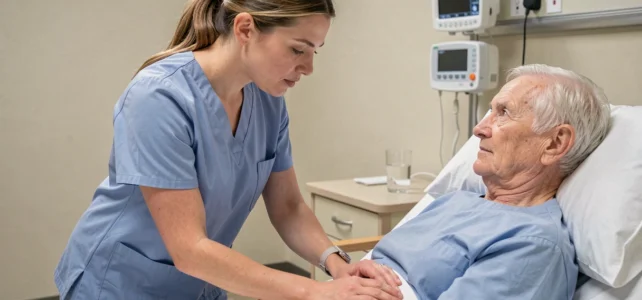
The scope of intervention for nursing assistants changed its legal foundation in 2026. The authorized actions are no longer listed in a separate regulatory text, but in a subsection of the decree of June 26, 2026, dedicated to nursing acts. This architectural choice alters the interpretation of the reference framework, the training obligations, and the daily responsibilities of professionals.
Decree of June 26, 2026: a new regulatory architecture for nursing assistant acts
Before 2026, the actions of nursing assistants were governed by texts distinct from those regulating the nursing profession. The decree of February 26, 2025, had already expanded the scope of competencies but remained a text focused on the nursing assistant profession.
The decree of June 26, 2026, breaks with this logic. Nursing assistant acts are now integrated into the decree setting the list of nursing acts, within a part A dedicated to professionals working within the scope of the nurse’s own role: nursing assistants, childcare assistants, and educational and social support workers.
This integration is not an administrative detail. It means that the nursing assistant’s scope is legally subordinate to the role of the state-certified nurse. Any future evolution of nursing acts could have a direct effect on what the nursing assistant is authorized to perform, without the need for a new specific text.
To understand in detail the blocks of competencies before and after the reform, the new AS reference framework 2026 deserves careful reading as the differences with the previous framework are significant.

Comparison of the 2021-2025 reference framework and the 2026 framework: what changes in authorized acts
The table below summarizes the main differences between the framework resulting from the 2021 reference (supplemented by the decree of February 26, 2025) and the new system of 2026.
| Criterion | 2021 Reference/2025 Decree | Framework from the decree of June 26, 2026 |
|---|---|---|
| Legal support | Specific texts for the nursing assistant profession | Subsection in the decree of nursing acts |
| List of acts | Expandable by establishment protocol | Closed list, with no room for local interpretation |
| Hierarchical link | Collaboration with the IDE, flexible framework | Explicit subordination to the nurse’s own role |
| Local adaptation | Possibility of internal protocols | No extension by establishment protocol |
| Updating training | Mandatory for graduates before 2021 | Maintained, content aligned with the new list |
The most structuring point is the closure of the list. Before 2026, some establishments could, through internal protocols, assign their nursing assistants tasks not explicitly provided for by the texts. This type of local extension is no longer possible since the decree of June 26, 2026.
Closed list of nursing assistant acts 2026: practical consequences in establishments
A closed list means that each act that a nursing assistant can perform is specifically listed in the text. If an action is not included, it is prohibited, even if the care team believes that the nursing assistant has the technical competence to perform it.
The consequences are direct for health managers and establishment directors:
- Existing internal protocols must be audited to ensure that no delegated act exceeds the regulatory list of 2026.
- The legal responsibility of the establishment is engaged if a nursing assistant performs an act outside the scope, even on the oral instruction of a nurse.
- Job descriptions and internal professional references must be updated to strictly reflect the new framework.
For the nursing assistants themselves, this closure brings clarification. The ambiguity surrounding certain delegated actions disappears in favor of a readable, but more rigid framework.
Hygiene care, clinical monitoring, and technical gestures
The authorized acts still cover hygiene and comfort care, monitoring of clinical status (taking vital signs, observing warning signs), and certain technical gestures such as endotracheal suctioning on an established device. The decree of February 26, 2025, had expanded these technical gestures. The 2026 text reiterates them without further broadening their scope, but by locking in their perimeter.

Updating training for nursing assistants: who is concerned
The obligation for updating training concerns nursing assistants holding a diploma issued before the 2021 reengineering. This obligation, introduced by the decree of July 23, 2021, remains in effect under the new framework.
The training generally takes place over three days in person. It covers the execution of the new authorized care, clinical evaluation within the limits of the profession, and teamwork in a multidisciplinary setting.
In contrast, nursing assistants trained after 2021 according to the reference framework with five competency blocks and eleven key competencies are not required to undergo this update. Their initial training already incorporates the developments of 2025. However, the educational content of the updating sessions will need to be revised to integrate the logic of the closed list specific to the 2026 framework.
AS 2026 reference framework and nurse-nursing assistant collaboration: a strengthened link
The inclusion of nursing assistant acts in the decree of nursing acts is not just a drafting choice. It formalizes a clearer functional subordination. The nursing assistant operates within the scope of the nurse’s own role, not in parallel.
This evolution changes the team dynamics. The state-certified nurse remains the guarantor of the coherence of delegated care. Their supervisory responsibility is reinforced, as the text does not provide any mechanism for autonomous delegation for the nursing assistant outside the scope of their own role.
For establishments facing difficulties in recruiting nurses, this formalized subordination poses an organizational challenge. Without a nurse present or reachable, the nursing assistant cannot expand their interventions to compensate for a staffing shortage. The closed list and attachment to the nurse’s own role create a protective framework for the patient, but demanding in terms of team planning.
The regulatory framework of 2026 redraws the contours of the nursing assistant profession with a precision that previous texts did not offer. This rigor protects professionals as much as it constrains them, and obliges each establishment to reassess its delegation practices in light of a list of acts that no longer tolerates interpretation.