
The tire pressure on a Citroën C5 is reset from the central screen or the dashboard, depending on the vehicle generation. The procedure differs between a C5 II, a C5 III, and a C5 Aircross, both in the menu access path and in the type of embedded TPMS sensors. Comparing these variants allows you to target the correct method without guesswork.
Indirect or direct TPMS: what changes by C5 generation
Before touching any button, identifying the type of embedded pressure monitoring system determines the entire process. The indirect TPMS uses ABS sensors to detect a change in rolling diameter. The direct TPMS uses physical sensors mounted in each wheel, which measure pressure in real-time.
| Generation | TPMS Type | Reset Access | OBD Tool Required |
|---|---|---|---|
| C5 II (2008-2017) | Indirect (ABS sensors) | Dashboard menu / stalks | No (unless persistent warning) |
| C5 III / C5 X | Indirect | Central touchscreen | No |
| C5 Aircross | Indirect | Touchscreen, Vehicle menu | No |
On all three generations, the TPMS system is mandatory and cannot be disabled. Only the reset (the “reset”) is accessible to the driver, after correcting the pressure or swapping tires.
To easily reset the C5 tire pressure, you must first ensure that all four tires are inflated to the recommended value, measured when cold. The reset does not correct insufficient pressure; it recalibrates the reference of the control unit.
Tire pressure reset for Citroën C5 Aircross and C5 X: touchscreen procedure
On the C5 Aircross and recent C5 models equipped with a central screen, the procedure goes through the onboard menu. No external tools are required.

- Inflate all four tires when cold according to the values indicated on the driver’s door label (the values vary depending on the engine, tire size, and vehicle load).
- Turn on the ignition without starting the engine, then access the “Vehicle” menu on the central touchscreen.
- Select “Reset under-inflation detection” or “Tire pressure reset” depending on the version of the onboard software, then confirm.
- Drive a few kilometers for the system to recalculate the references. The TPMS warning light turns off once the recalibration is complete.
The key point to remember: the correct value is not read on the tire sidewall. The pressure indicated on the sidewall corresponds to the maximum pressure supported by the tire, not the one recommended by Citroën for your engine and rims.
Where to find the correct inflation pressure
The label affixed to the driver’s door pillar remains the reference source. It indicates two sets of values: one for normal loading, another for a loaded vehicle or driving on the highway. The user manual repeats this data.
Specialized sites like Pressionpneu.com or Oponeo publish tables by model and tire size. These tables are useful for checking a value, but the manufacturer’s label always takes precedence in case of discrepancy.
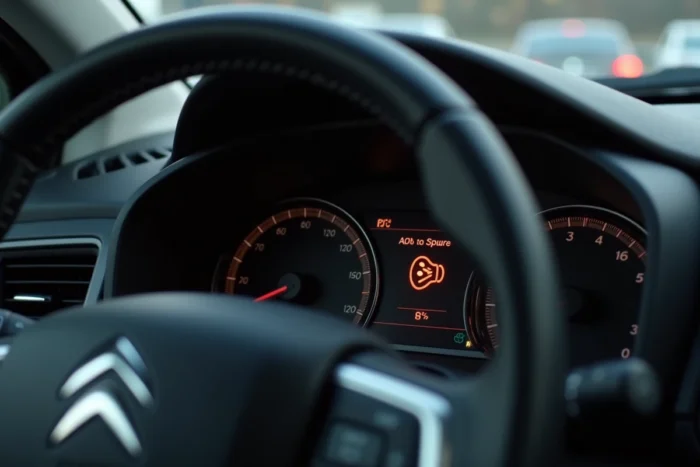
Tire pressure warning light stays on after inflation: diagnosis on C5 II
On C5 II (2008-2017), the reset generally goes through the steering wheel controls or dashboard stalks, without a touchscreen. Navigation through the menus varies depending on the equipment level.
However, it is on this generation that field reports indicate the most persistent warning lights after a reset. Several technical causes explain this behavior:
- A faulty ABS sensor skews the measurement of the rolling diameter, and the indirect TPMS interprets the discrepancy as a loss of pressure.
- A TPMS sensor battery nearing the end of its life (on versions equipped with direct sensors as optional) no longer transmits a usable signal.
- A tire whose pressure differs even slightly from the newly recorded reference can keep the warning light active for several dozen kilometers.
If the warning persists after correct inflation and a validated reset, visiting a garage with an OBD diagnostic tool allows reading the fault codes from the TPMS control unit. This diagnosis identifies whether the problem comes from a physical sensor, the electronic module, or a simple calibration offset.
Faulty TPMS sensor: replacement or recalibration
A non-functioning direct sensor requires physical replacement in the affected wheel, followed by pairing with the control unit via a diagnostic tool. This operation is done in a garage.
For the indirect TPMS, no dedicated sensor exists in the wheel. The problem is then at the level of the ABS sensor or the control module. The cost of replacing an ABS sensor is significantly lower than that of a set of four direct TPMS sensors.
Tire swapping and changing: when the reset becomes mandatory
The reset is not reserved for situations where the warning light comes on unexpectedly. It must be triggered systematically after any intervention that modifies the pressure or geometry of the wheels.
After a front/rear swap, the rolling diameters change position. Without a reset, the indirect TPMS compares the new values to the old references and may trigger a false alert. The same phenomenon occurs when switching to winter tires or mounting rims of different sizes.
Every tire change requires a TPMS reset, even if the inflation pressure is the same. The control unit needs a new baseline to function correctly.
On the C5 Aircross and C5 X, this recalibration takes a few seconds via the touchscreen. On C5 II, navigating the dashboard menus requires a bit more patience but remains accessible without professional equipment. In both cases, driving a few kilometers at moderate speed is enough for the system to validate the new references and permanently turn off the warning light.