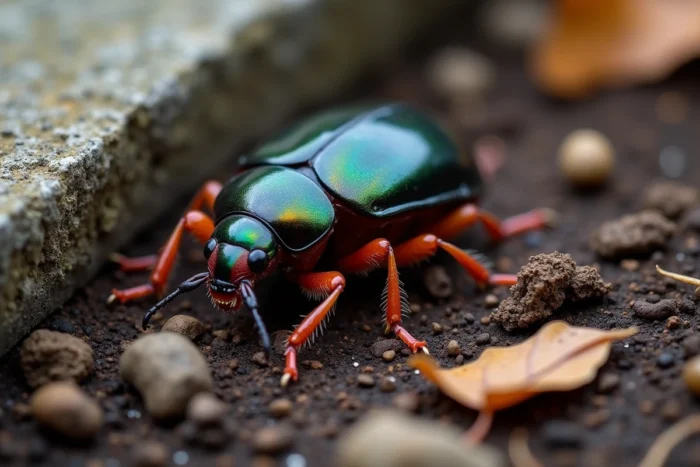
A small reddish-brown beetle, quick, that darts across your terrace at dusk. You squash it, you sweep it away, it comes back. The pseudoophonus rufipes, also known as the strawberry ground beetle or red-legged ophone, causes waves of concern among homeowners every summer. Good news: this insect is neither a cockroach nor a pest in the strict sense, and getting rid of it relies on simple actions once you understand what attracts it to your home.
Pseudoophonus rufipes and artificial light: the real trigger for invasions
Have you noticed that these beetles mainly appear around outdoor lamps, on illuminated walls, or near large windows? It’s no coincidence. The pseudoophonus rufipes is strictly nocturnal and highly attracted to artificial light. This light-seeking behavior transforms a discreet garden insect into an invading visitor in your home.
Specifically, a halogen spotlight left on all night on a terrace acts like a magnet. The red-legged ophones then leave the bare soil or lawn areas where they usually live to converge towards the light source. They then find themselves on facades, door thresholds, and sometimes inside if a window is ajar.
The most effective measure is also the simplest: turn off unnecessary outdoor lights as soon as night falls. If you need security lighting, opt for a yellow or amber LED bulb. These wavelengths attract far fewer nocturnal insects than white light. Reducing light leakage into the garden (curtains, shutters, blinds) also significantly limits intrusions.
Several naturalist portals from regional parks (Écrins, Pays de la Loire, Normandie-Maine) confirm that this approach through light management yields better results than any chemical treatment against this species. If you’re looking for more tips for pseudoophonus rufipes in the house, the logic remains the same: act on what attracts them rather than on the insect itself.

Strawberry ground beetle in the vegetable garden: real damage and false culprit
The common name “strawberry ground beetle” suggests that this insect devours your strawberries. The reality is more nuanced. The pseudoophonus rufipes is an omnivorous beetle that primarily feeds on seeds and small invertebrates. It consumes slugs, snails, and larvae of other harmful insects.
Damage to fruits (strawberries, raspberries) does occur, but it remains limited and mainly affects fruits that are already damaged or in direct contact with the soil. Clean mulching and raising strawberries on mounds often suffice to solve the problem.
Why professionals do not treat against this species
Naturalist databases classify the pseudoophonus rufipes as a beneficial agent in regulating soil pests. Pest control professionals generally do not recommend the use of contact insecticides against this species. The “zero pesticide” charters adopted by many French municipalities also exclude this type of treatment for green spaces.
Massively removing red-legged ophones from a garden would mean depriving oneself of a natural predator of slugs. The remedy would be worse than the disease.
Preventing pseudoophonus rufipes from entering the house
The intrusion into the home is the issue that generates the most concern. These beetles vaguely resemble cockroaches in size and color, which triggers a disgust reaction. A few mechanical adjustments can resolve the situation without chemicals.
- Door seals and door bottoms: check the tightness of the thresholds, especially sliding doors leading to the garden. A brush seal costing a few euros blocks most nocturnal intrusions.
- Window screens: they prevent the entry of all flying and crawling insects attracted by indoor light. Prefer models with fine mesh.
- Cleaning the immediate surroundings: the ophones hide during the day under stones, flower pots, and boards laid on the ground. Moving these shelters away from the facade reduces the pressure of intrusion.
If a few individuals do enter, a simple vacuum cleaner will do the trick. Release them at the back of the garden: they will resume their role as predators of slugs.
Managing the population of red-legged ophones in the garden without insecticide
The goal is not to eliminate the pseudoophonus rufipes from the garden, but to limit its concentration in sensitive areas (vegetable garden, terrace, house entrance). Here are the long-term levers that work.
Soil work and crop rotation
The larvae develop in the top few centimeters of soil. Regular hoeing around fragile crops exposes the larvae to predators (birds, hedgehogs) and reduces local density. Crop rotation also breaks the establishment cycle.
Encouraging natural predators
Hedgehogs, shrews, toads, and blackbirds readily consume ground beetles. A garden that welcomes this fauna (wood piles, wild hedges, water points) naturally maintains the populations of ophones at a reasonable level.
- Install a hedgehog shelter in a quiet corner of the garden.
- Leave an unmowed grassy strip along the edge of the vegetable garden to encourage competing predatory beetles.
- Avoid chemical slug repellents (metaldehyde), which poison the entire food chain and deprive the garden of its natural regulators.
A garden with balanced biodiversity rarely sees population explosions of a single species. Biodiversity remains the best long-term regulator.
Intercept traps for critical areas
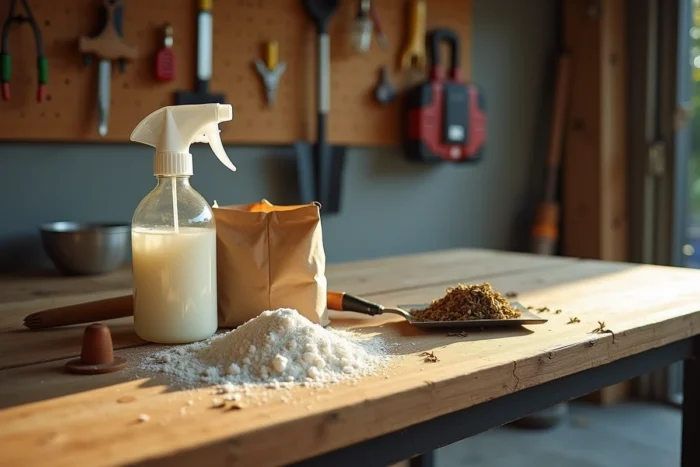
If the terrace or the house threshold remains a passage point despite light management, pit traps (cups buried flush with the ground, filled with soapy water) can capture individuals in transit. Place them along exterior walls, away from crops. Empty them every morning.
The pseudoophonus rufipes does not warrant panic or chemical treatment. Controlled light, mechanically blocked access, maintained biodiversity: these three axes are enough to transform an apparent invasion into peaceful coexistence with a beetle that is ultimately more useful than harmful.