Tansy (Tanacetum vulgare) colonizes roadsides, wastelands, and slopes without human assistance. This rhizomatous perennial from the Asteraceae family spreads naturally at a rate that raises as many practical as botanical questions. Before multiplying it in the garden, one must understand the mechanisms governing its expansion, and especially the limits to set to prevent it from becoming a problem.
Running rhizomes of tansy: the true engine of propagation
Sowing often captures the attention of novice gardeners. The small yellow flowers in buds do indeed produce viable seeds, but propagation by rhizomes is the dominant mode in common tansy. Below the soil surface, horizontal underground stems progress and generate new plants at a distance from the mother clump.
This root network explains why a single plant can cover a considerable area in just a few seasons. Feedback from permaculture gardeners converges on this point: a tansy planted freely in a cultivation bed eventually invades neighboring rows. Dividing clumps in spring or autumn directly exploits this network. One simply needs to cut a section of rhizome bearing at least one bud, then replant it at a shallow depth in well-drained soil.
To explore the methods for propagating tansy vegetatively or by sowing, division remains the most reliable technique in temperate climates. It produces already vigorous plants capable of flowering in the first year.
Sowing tansy in the garden: known conditions and limits
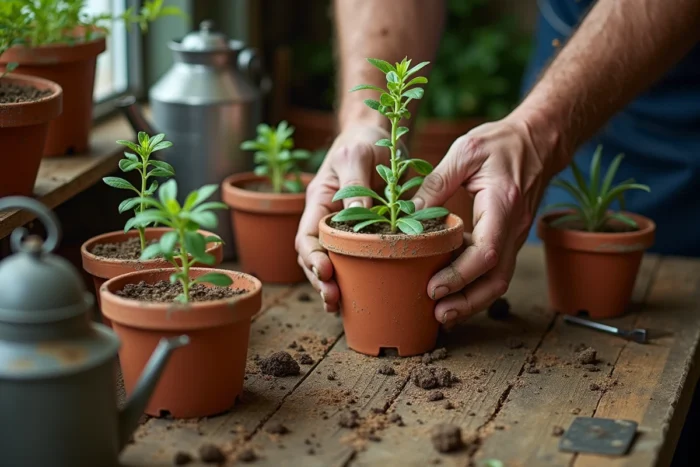
Sowing in the ground is done in spring, once the last frosts have passed. Tansy seeds are fine and require a very light covering of soil, or even just surface tamping. A warmed soil and sunny exposure favor germination.
The emergence remains unpredictable depending on the seed batches. Some gardeners report satisfactory germination rates in trays under cold shelter as early as the end of winter, followed by transplanting in place after the ice saints. Others experience repeated failures with seeds harvested late from wild plants.
On the other hand, a successful sowing produces seedlings that are slower to establish than a rhizome cutting. Flowering generally occurs in the second year. This method of multiplication has an advantage: it limits the risk of introducing running rhizomes into an area where tansy is not yet present, making subsequent control easier.
Invasive tansy: containing propagation in the vegetable garden
Several naturalist associations now classify common tansy among potentially invasive species in certain regions. This warning, recently communicated to the general public, changes the approach: propagating tansy requires planning a containment strategy from the start.
Practitioners of organic gardening and forest gardening recommend several strategies to benefit from its repellent properties without suffering from its colonizing nature:
- Plant tansy at the end of rows or in a buffer strip, never in the middle of a cultivation bed. This peripheral position allows for mowing or uprooting the overhanging stolons without disturbing the vegetables.
- Install a rhizome barrier (metal plate, thick tarp buried about thirty centimeters deep) around the dedicated area. This device slows down underground progression.
- Grow tansy in a large buried pot or in a raised bed. The container physically blocks the expansion of the rhizomes while keeping the foliage accessible for harvesting manure or decoction.
Without these precautions, tansy can colonize paths, borders, and neighboring beds in two or three seasons. Uprooting rhizomes established in clay soil then becomes a laborious task.
Tansy as a companion plant: where to place it for a repellent effect
The main interest of tansy in the vegetable garden lies in its terpenoid compounds (thujone, camphor) that repel several pests. Field reports mention effectiveness against the Colorado potato beetle, cabbage white, and carrot fly. Its fragrant foliage acts as an olfactory disruptor for insects that locate their host plants by smell.
Placing tansy at the edge of the plot, on the side of the prevailing wind, maximizes the diffusion of its volatile compounds. A few plants are enough to cover a row of potatoes or cabbages. Beyond the direct repellent effect, the flowering in yellow buds attracts beneficials (hoverflies, lacewings) that help regulate aphids.

Harvesting foliage for organic preparations
Tansy manure and decoction are prepared from foliage harvested before or during flowering, when the concentration of active ingredients is highest. Cutting the stems halfway stimulates regrowth and allows for two to three harvests per season from the same plant.
The fresh foliage is macerated in rainwater to obtain a manure usable for foliar application or watering at the base of sensitive plants. The decoction (boiled then filtered foliage) offers a more concentrated action, suitable for spot treatments against declared infestations.
Multiplying tansy in the garden: what to remember before starting
Tansy multiplies easily, perhaps too easily. Dividing rhizomes remains the fastest and safest method to obtain productive plants. Sowing is suitable for gardeners who want to limit the risk of invasion, at the cost of a slower establishment.
Regardless of the propagation method chosen, the issue of containment must precede that of multiplication. A buried pot or a physical barrier avoids hours of future weeding. Tansy provides real benefits to the organic vegetable garden, provided clear boundaries are set from the moment of planting.