
The Triban RC 120 has long held a unique place in the Decathlon catalog: an accessible road bike, versatile enough for commuting as well as weekend rides. Since this model is no longer in production, the RC 120 fleet now consists of used bikes or end-of-line models. Improving the comfort of this frame involves transferable accessories for a future bike, rather than heavy modifications.
Transferable accessories: the logic that applies to an end-of-line bike
When a model is removed from the catalog, specific frame parts become harder to source. The RC 120, with its aluminum frame and rigid fork, remains mechanically reliable. The question of comfort mainly arises at the contact points: saddle, handlebar tape, pedals.
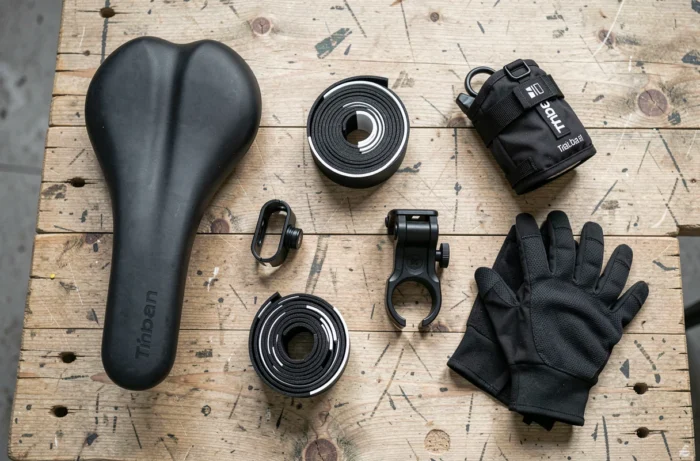
Investing in transferable comfort accessories (saddle, lighting, bag, pedals) protects the investment. The day the RC 120 is replaced by a newer model, these elements can be transferred without loss. This is a more rational approach than replacing the crankset or drivetrain on a bike whose residual value remains modest. A comprehensive guide lists the Triban RC 120 accessories on Blaye Automobiles to prioritize the essentials.
Saddle and handlebar tape: the two contact points that change everything on the Triban RC 120
The original saddle mounted on the RC 120 is suitable for short rides. Beyond an hour, feedback varies on this point: some cyclists adapt, while others report recurring perineal pain. The issue is less about the quality of the saddle than its standardized shape, which does not suit all body types.
Replacing the saddle with a model suited to the width of one’s sit bones is the first upgrade to consider. Several brands offer measuring tools in-store. A saddle that is too narrow compresses soft tissues, while a saddle that is too wide causes chafing on the inner thighs.

The handlebar tape deserves the same attention. The original handlebar tape provides limited cushioning. Switching to a thick tape with integrated gel reduces vibrations transmitted to the palms and wrists, especially on degraded surfaces encountered in urban areas. This is a low-cost change that can be done in under thirty minutes with a screwdriver and adhesive tape.
Tires and pressure: the most underestimated comfort lever
The Triban RC 120 can accommodate wider tires than those originally mounted. Upgrading to a larger section allows for lower pressure, which absorbs road irregularities more effectively. The comfort gain is immediate and noticeable from the first kilometers.
Three criteria guide the choice of tires:
- The maximum section compatible with the frame and fork, to be checked by measuring the available clearance at the seat stays and fork
- The tread profile, smooth for exclusive road use, slightly knobby for alternating between road and stabilized paths
- Puncture resistance, a crucial parameter for commuting where a flat tire means being late for work
Adjusting the pressure to the cyclist’s weight and tire width is as important as the choice of model. An over-inflated wide tire loses all its comfort advantage. Manufacturers indicate pressure ranges on the tire sidewall, but the appropriate value often lies in the lower half of this range for urban use.
Bicycle lighting and 2024 regulations: what has changed for cyclists
The decree n° 2024-1074 of November 29, 2024 has modified the French Highway Code regarding bicycle lighting. Cyclists can now use light devices integrated into a helmet or vest, as well as a non-flashing rear stop light and orange turn signals.
These items remain optional. They must complement, and not replace, the mandatory white front light and red rear light. For comfort and safety on a Triban RC 120 used for commuting, effective lighting is among the priority accessories, especially during winter when journeys are made in darkness.
A front light of at least several hundred lumens and a rear light with a flashing mode constitute the functional minimum. USB rechargeable models attach and detach quickly, preventing theft when the bike is parked outdoors.
Flat or automatic pedals: a choice that depends on the journey
The original pedals of the RC 120 are basic flat pedals. Replacing them improves either comfort or pedaling efficiency, depending on the option chosen.
- Wide platform flat pedals with pins provide better foot support and distribute pressure over a larger surface, reducing pain under the arch of the foot
- Automatic pedals attach the foot to the pedal via a cleat system, allowing for pedaling by pulling as well as pushing
- Mixed pedals (automatic on one side, flat on the other) are suitable for commuting: automatic side with cycling shoes, flat side with casual shoes
Switching to automatic pedals requires purchasing compatible shoes. For exclusively urban use on short trips, quality flat pedals are sufficient to improve comfort without the need for additional equipment.
The Triban RC 120, even though it is no longer in the Decathlon catalog, remains a bike on which these five components (saddle, handlebar tape, tires, lighting, pedals) transform the riding experience. Each of these accessories can be transferred to a future road or gravel bike, making the investment sustainable beyond the lifespan of the frame itself.