
Organizing a dream trip today involves dealing with parameters that go beyond simply choosing a destination on a map. Changing climate, increased administrative requirements for long-term stays, a shift in demand towards cultural experiences rather than beach lounging: the framework for planning a trip has significantly changed over the past two years.
Coolcations and seasonal shifts: rethinking the travel calendar
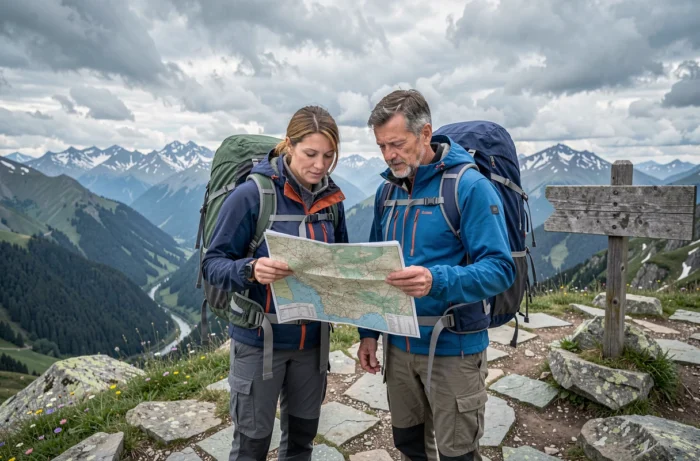
The rise in summer temperatures in the Mediterranean basin and Southeast Asia has given rise to a phenomenon identified as coolcation. The principle: favor destinations at high altitude or high latitude during the months when classic spots become stifling.
Travel trend reports for 2024-2025 (notably from Euronews Travel) cite this shift in demand as one of the most significant movements in the market. Travelers who would have chosen Greece or southern Spain in July are now turning to Iceland, Norway, Scotland, or the Italian Dolomites.
This logic of seasonal shifting has a direct effect on the budget. Traveling outside of heat peaks in temperate areas often allows access to lower accommodation rates, as tourist traffic remains moderate. Conversely, flights to these less-served destinations can be more expensive, especially from France. The financial gain is therefore not automatic, and comparing the overall cost (flights, accommodation, local living) remains the only reliable method.
For those who wish to explore organized itineraries based on this logic, the travel page of Voyage 2 Rêve offers routes in various destinations, including those off the usual beach paths.
Digital nomad visa: health insurance as a blocking criterion
Working remotely from abroad has become a full-fledged mode of travel. Several European (Spain, Greece) and Asian (Japan) countries have implemented visas dedicated to digital nomads. Since 2024, the conditions for obtaining these visas have tightened on one specific point: health insurance has become the primary reason for refusal.
In Spain, the legal framework requires private or public health insurance taken out with an insurer authorized to operate in the country. A standard French policy, even with a “worldwide” extension, is not sufficient if it is not recognized by local authorities.
This tightening changes the game for French nationals who are leaving to work for several months abroad. Before even looking for accommodation or a coworking space, one must check:
- That the chosen insurer is authorized in the destination country, not just in France
- That the coverage includes medical repatriation and routine care, two points often absent from cheap “nomad” plans
- That the duration of coverage exactly matches the duration of the requested visa, as a discrepancy of a few days can lead to a refusal
The processing of applications varies from one consulate to another: a file rejected in Madrid may be accepted in Barcelona with the same documents. Anticipating several months ahead and building a solid application remains the only defense.
Cultural immersion or adventure: what travelers really choose
Recent trend analyses show that travelers now prioritize cultural immersion over adventure and luxury. This shift changes the way itineraries are constructed.
A dream trip in 2025-2026, for an increasing portion of demand, resembles less a sequence of spectacular sites and more a stay focused on a limited territory. Spending ten days in a single region of Japan, learning the basics of local cuisine in Mexico, following an artisan in Portugal: these formats are gaining ground against panoramic tours.
This choice has practical consequences. A focused itinerary reduces internal transport costs but often increases accommodation budgets (longer rentals in residential neighborhoods rather than in tourist areas). It also requires more detailed preparation: identifying the right local contacts, spotting workshops or venues that welcome visitors without falling into the standardized “authentic experience” circuit.

Building an itinerary around a central theme
Rather than listing “essentials,” starting from a personal theme gives a backbone to the trip. This could be a product (coffee, from Colombia to Ethiopia), a craft (ceramics, from Morocco to Japan), or a geographical question (river deltas, from the Mekong to the Danube).
A trip organized around a theme rarely costs more than a classic tour, but it requires more research in advance. Specialized paper guides, niche blogs, and local forums remain more useful than generalist aggregators for this type of preparation.
Travel budget: the items that online calculators often overlook
Most online travel budget calculators include flights, accommodation, food, and activities. Three items regularly slip under the radar:
- Foreign banking fees, which can represent a significant portion of a trip lasting several weeks outside the eurozone
- Specific insurances (cancellation, local health, liability), especially since the tightening of documentary requirements in several countries
- The actual cost of internal transfers in countries where the transport network is not centralized: taxis, ferries, domestic flights purchased at the last minute
Europe remains one of the areas where leisure tourism expenses are among the highest in the world. This observation reminds us that traveling in Europe is not necessarily synonymous with cheap travel, even for French travelers who do not have to manage visas or time zone differences.
A well-prepared dream trip depends on the adjustment between the actual budget, the desired travel pace, and the current administrative constraints. Parameters change quickly: checking entry and insurance conditions a few weeks before departure, even when everything seems settled, avoids unpleasant surprises at boarding.