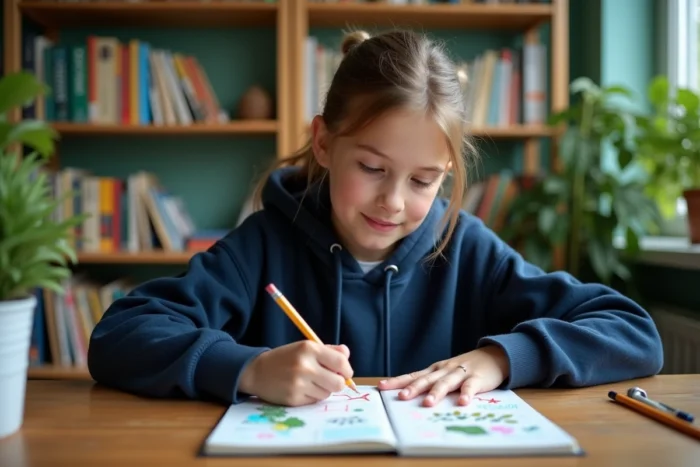
An SVT notebook without a cover page, we all know the result: loose sheets that get mixed up, an anonymous binder at the bottom of the bag, and a student who takes three minutes to find the right material at the start of class. The printable SVT cover page solves this problem in seconds, while giving the notebook a visual identity that lasts the year.
Choosing an SVT cover page model suitable for the school level
We don’t offer the same visual to a sixth grader discovering life and earth sciences as to a high school student preparing a project on ecology. The choice of model primarily depends on the actual use of the notebook.
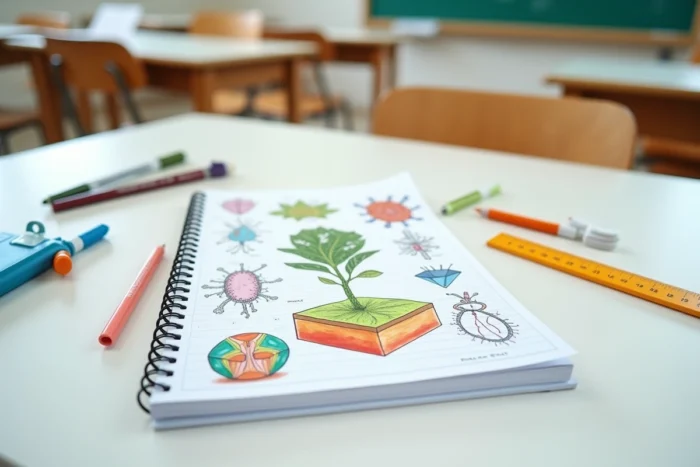
In middle school, coloring cover pages work well. They depict cells, leaves, a microscope, the human body. The student personalizes them with colored pencils or markers, creating a concrete connection with the subject right from the start of the school year.
In high school, we lean towards more streamlined models, with a space for the name, class, school year, and possibly the themes of the curriculum (health, environment, genetics). The resources offered by Mister Papa allow for free downloads of ready-to-use models, suitable from middle school to high school.
An overly busy model with illustrations will be abandoned by a teenager, while a model that is too plain won’t attract a fifth grader. The right compromise is a visual that leaves space for writing and a free area for drawing or sticking a personal element.
Printing and paper: the technical constraints to anticipate
Downloading a PDF is the easy part. Printing, however, often poses practical problems that template sites do not mention.
Format and printer compatibility
The majority of SVT cover pages are in A4 portrait format. Before printing, check that the file is indeed in PDF format (not in low-resolution image) and that the “fit to page” option is disabled. Otherwise, the margins will shift everything, and the visual will come out cropped or reduced.
A standard inkjet printer is sufficient for color use. In black and white, the result depends on the density of the model: very colorful illustrations become a mush of gray. Opt for models with sharp outlines for black and white printing.
Paper weight and durability in the notebook
Standard printer paper (about 80 g/m²) is suitable for gluing the cover page onto a notebook cover. For a binder or display book, a slightly denser weight prevents the sheet from wrinkling at the first touch.
- Standard paper: suitable for gluing on notebook covers, dries quickly with glue stick.
- Light cardstock: better durability in a binder, but some consumer printers may not accept it (check the rear tray).
- Photo or glossy paper: superior visual result, but glue adheres poorly and the price per sheet rises quickly when printing multiple subjects.
Feedback varies on this point, but in practice, standard paper remains the most reliable choice for most family configurations.
SVT cover pages as an organizational tool for the notebook
The cover page is often reduced to a decorative role. In practice, it mainly serves as a visual marker in a notebook that will accumulate dozens of pages throughout the school year.
A well-designed cover page structures the notebook even before the first class. Some teachers ask for the major themes of the SVT curriculum to be included: the planet Earth, living organisms and their evolution, the human body and health. This transforms the cover into a visual summary.
Intermediate cover pages can also be used to separate chapters or terms. In this case, multiple copies of the same model (or coordinated models) are printed and interleaved in the notebook. This is particularly useful with a large notebook or binder.
The “all subjects” packs found on social media (TikTok, Instagram) often offer coherent series: the same graphic style for SVT, math, French, and history-geography. A notebook with a visual identity by subject is found more quickly in a bag, especially in sixth grade when the student juggles between several classrooms.
Personalizing an SVT cover page with colored pencils or markers
Coloring models remain the most popular for middle school students. The principle is simple: print a model with black and white illustrations (plant cell, DNA, animals, plants) and the student colors it according to their tastes.
To ensure the result lasts the entire school year, a few practical choices make a difference:
- Colored pencils provide a durable finish and do not bleed through the paper, even on 80 g/m².
- Fine-tipped markers allow for precise coloring on small details (leaf veins, cell diagram), but wide-tipped markers can warp standard paper.
- A fine black marker for tracing the outlines after coloring gives a sharper and more professional look to the final result.
Coloring their cover page is also a moment of transition to the new school year. It has been observed that students who personalize their notebooks themselves are more invested in the first weeks of class, making it easier to get to work.
For students who prefer a quicker result, already colored models for direct printing are also available. They are better suited for high school students or those who do not enjoy drawing.
Adapting the visual to the themes of the SVT curriculum
The new science and technology programs published in the Official Bulletin reinforce the place of education in health, environment, and scientific citizenship. A cover page that reflects these axes gives meaning to the notebook from the start.
Specifically, the choice of model can be guided by the dominant themes of the year. In fifth grade, a visual focused on geology and ecosystems aligns with the curriculum. In third grade, illustrations on genetics or the immune system are more relevant.
The visual of the cover page is not just aesthetic; it announces the content of the notebook. A student who sees a double helix of DNA on their cover immediately knows which notebook to look in for their lesson on heredity.
Some teachers provide a mandatory model at the beginning of the year. In this case, personalization comes through coloring and adding elements (calligraphed name, small drawing in a free corner) rather than choosing the model. Checking the teacher’s instructions before printing avoids having to redo it in the first week of September.