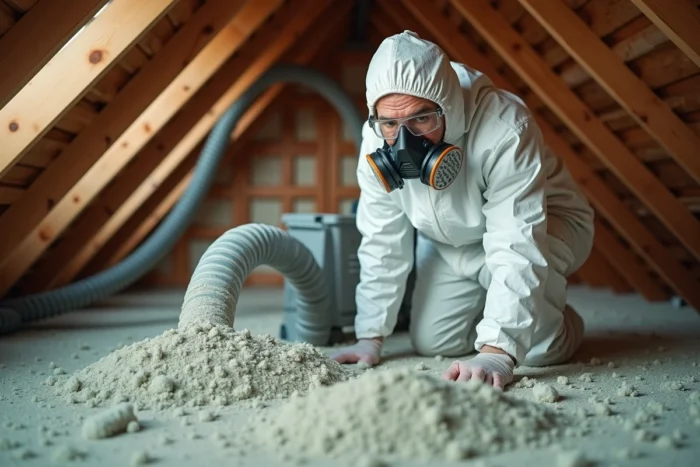
The settling of cellulose wadding is not an inevitability linked to the material itself. It is a defect in implementation, almost always traceable to insufficient blowing density or a lack of post-construction control. We observe in the field that the vast majority of settling incidents could have been avoided with a rigorous installation protocol and follow-up a few weeks later.
Blowing density and control gauges: the technical duo to master
The actual blowing density determines the mechanical behavior of the wadding over time. In lost attics, a density that is too low allows the fibers to reorganize under their own weight, creating areas of lesser thickness and progressive thermal bridges. The target density depends on the application: horizontal blowing or vertical insufflation, and each manufacturer publishes its minimum values in the Technical Notice of the product.
The problem is that the density at the machine output does not always correspond to the density on the ground. The operator adjusts the air flow and material flow, but without physical verification, the consistency of the blowing remains uncertain. This is where the control gauges come into play.
These markers, placed in the attic floor before blowing, allow for checking the thickness achieved at different points. We recommend complementing this control with a weighing: record the mass of wadding delivered, subtract the unused bags, and relate the total to the covered area. If the mass/area ratio is below the manufacturer’s recommendations, the density is insufficient, regardless of the apparent thickness.
By following the practical advice from Murmures Déco, you will find a complementary approach to identify warning signals as soon as the site is received.
Post-construction follow-up of cellulose wadding: measuring actual settling
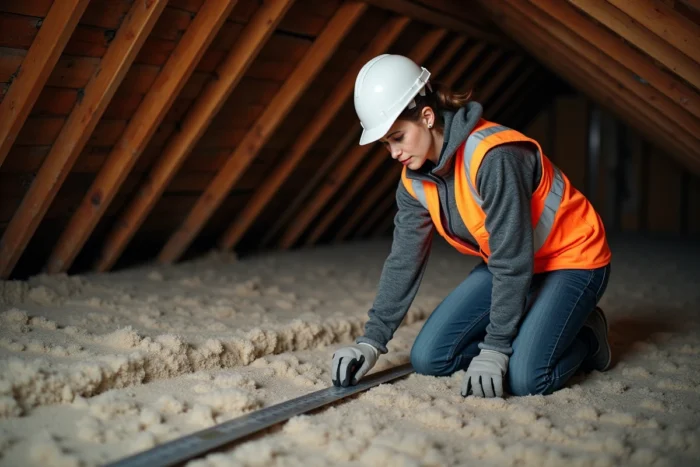
A good installation does not exempt from deferred control. Returning to the attic a few weeks after blowing allows for quantifying the initial settling, which generally stabilizes in the first months. The gauges installed during the construction serve as a reference: the difference between the initial level and the observed level provides the value of actual settling.
This measurement is not trivial. It allows for distinguishing normal settling (a few centimeters, anticipated by the over-thickness calculation) from abnormal settling revealing a density defect. If the gap exceeds the margin specified by the Technical Notice, a partial re-blowing remains possible without removing the entire insulation.
We find that this follow-up step is rarely offered by blowing companies, even though it constitutes the best guarantee for the project owner.
Structural load of the ceiling and wadding insulation: an underestimated parameter
Settling is not just a thermal issue. When increasing the thickness of cellulose wadding to achieve high thermal resistance, the total mass of insulation per square meter of ceiling can become significant. Checking the load-bearing capacity of the framework before blowing is a technical precaution that many craftsmen neglect.
On ceilings made of plasterboard fixed to spaced joists, the admissible load depends on the section of the joists, their spacing, and the clear span. A ceiling designed to support its own weight and lighting is not necessarily intended to receive a thick layer of loose insulation.
If the load approaches the admissible limit, two solutions exist:
- Reinforce the framework by adding braces or doubling the most stressed joists before any insulation intervention
- Install a technical floor on the joists to distribute the load and create a circulation plane in the attic without crushing the wadding
- Reduce the blowing thickness and compensate with additional insufflation in the slopes if the configuration allows
Moisture management and vapor barrier: avoiding settling through mass absorption
Cellulose wadding is a hygroscopic material: it absorbs and releases water vapor according to ambient conditions. This regulation capacity is an asset under normal operating conditions. However, prolonged accumulation of moisture weighs down the fibers and accelerates settling irreversibly.
The classic scenario is an absence or improper positioning of the vapor barrier. In winter, the water vapor produced in living spaces migrates to the attic. Without a vapor barrier on the warm side, this vapor passes through the ceiling and condenses in the insulating mass. The wadding becomes waterlogged, heavy, and gravity does the rest.
The vapor barrier (or hygroscopic variable vapor barrier) must be installed on the heated side, with particular care at junctions and duct crossings. The specific points to monitor include:
- The access hatches to the attic, often left untreated, which create a major hygrometric short circuit
- The passages for recessed lights, which perforate the vapor barrier and concentrate vapor in specific areas
- The wall/ceiling junctions where the vapor barrier must be connected to the coating or wall vapor barrier to ensure continuity
Insufflation in vertical walls: density and confinement against settling
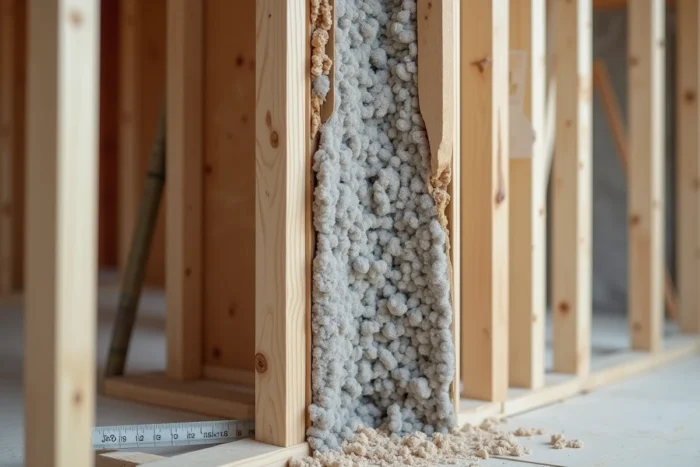
In wall insulation by insufflation, the risk of settling follows a different logic. The wadding is injected under pressure into a closed box, and it is the confinement that maintains the density. A poorly closed box or an insufficiently tensioned membrane allows the wadding to relax and settle by gravity.
The height of the box exacerbates the phenomenon. On a single-story wall, the risk is moderate. On two levels without intermediate overlap, the column of wadding exerts downward pressure that can create a void at the top. We recommend cutting the boxes every two meters or so with a rigid element (battens, braces) to limit the height of free fall of the fibers.
Control is done here by weighing the insufflated material relative to the volume of the box. If the injected mass corresponds to the density prescribed by the manufacturer, the settling will remain within acceptable margins over the entire lifespan of the insulation.
Preventing settling relies on three concrete levers: a compliant and verified installation density, a continuous and airtight vapor barrier, and post-construction follow-up with physical markers. None of these levers are costly, but each requires rigor. A well-executed cellulose wadding project maintains its thermal performance without intervention for decades.