Cellular polycarbonate allows a large portion of infrared rays to pass through, causing a temperature rise that is much higher than that of the outside from the first warm days of June. A conservatory equipped with this type of roofing can become unmanageable in the afternoon, even with a fan running. The problem does not stem from the material itself, but from its transparency to thermal radiation, which few interior devices can compensate for once the heat has entered.
Multilayer Polycarbonate: A Often Overlooked Roofing Renovation
Most guides on refreshing a polycarbonate conservatory suggest using blinds, films, or ventilation. A more structural option exists: replacing aging panels with a multilayer polycarbonate lining. This type of panel creates an insulating air layer between its layers, which slows down heat transmission without altering the load-bearing structure of the conservatory.
The advantage of this approach is twofold. It improves thermal comfort in summer, but also in winter, unlike a simple adhesive film that only addresses solar rejection. Field reports vary on this point: some installers report a noticeable gain from the first hot season, while others downplay the effect if the conservatory faces directly south with large glazed side surfaces.
The additional cost compared to a standard panel replacement remains moderate, and the operation does not require prior declaration if the surface and height remain unchanged. To delve deeper into this topic, several practical tips on L’Atelier du Bricolage detail options for reducing heat specific to polycarbonate roofs.
External or Internal Solar Protection: The Hierarchy That Changes Everything
An interior blind or reflective curtain does not produce the same effect as a protection placed outside the conservatory. The reason is physical: once solar radiation has passed through the polycarbonate, it heats the indoor air and surfaces. An interior device then attempts to send this heat back towards the glazing, but a significant portion remains trapped.
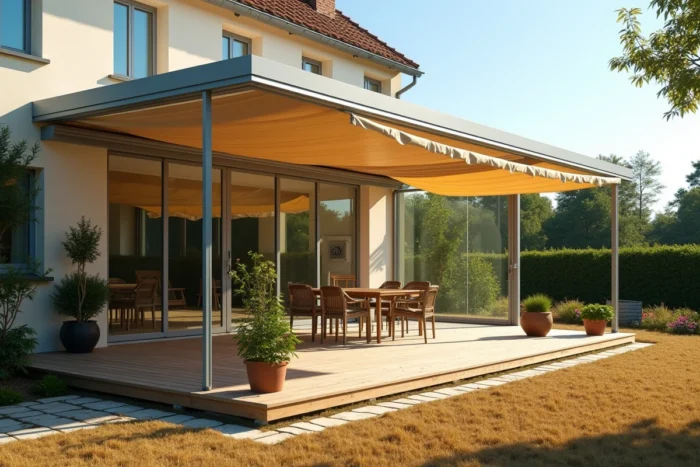
External protections (awnings, adjustable sunshades, roof roller shutters) intercept radiation before it reaches the polycarbonate. Several professional sources confirm that external protections block heat much more effectively than interior devices.
Criteria for Choosing Suitable External Protection
- The orientation of the conservatory: a south or southwest exposure requires a device covering the entire roof, not just the side facades
- Wind resistance: a standard awning retracts beyond a certain wind threshold, while an adjustable sunshade remains in place and continues to filter
- Automation: an automated system with a light sensor adjusts the protection in real time, preventing oversights during prolonged absences
On the other hand, special thermal film for polycarbonate remains an interesting first-level solution when the budget or the roof configuration does not allow for the installation of external protection. This type of film rejects a significant portion of solar energy and lowers the indoor temperature by several degrees without heavy work. Its lifespan is estimated at around ten years according to manufacturers, and the installation remains reversible.
Nocturnal Ventilation: An Underutilized Autonomous Lever
Ventilating a polycarbonate conservatory during hot hours is counterproductive. The outside air often exceeds the indoor temperature between noon and 5 PM, and opening the windows only worsens the situation. The strategy documented by several industry professionals is based on a simple principle: ventilate early in the morning or in the evening, then close the conservatory before the temperature rises.
Cross ventilation amplifies this effect. It requires at least two openings located on opposite walls to create a cross-flow of air. If the conservatory only has openings on one facade, adding an extractor fan at the top of the roof can partially compensate for the lack of natural draft.
Combining Ventilation and Thermal Inertia
A tiled or concrete slab floor accumulates the coolness of the night and slowly releases it in the morning. In contrast, a composite wood floor or a floating floor on joists offers little inertia and allows the temperature to rise quickly. The choice of flooring directly influences the duration of passive cooling.
Combining rigorous nocturnal ventilation with a high-inertia floor allows for delaying the moment when the conservatory becomes uncomfortable by several hours, without resorting to air conditioning.
Thermal Film, Reflective Paint, or Air Conditioning: Decide Based on the Case
Not all surface solutions are equal. Thermal film for polycarbonate and reflective solar paint are sometimes presented as interchangeable, but their uses differ.
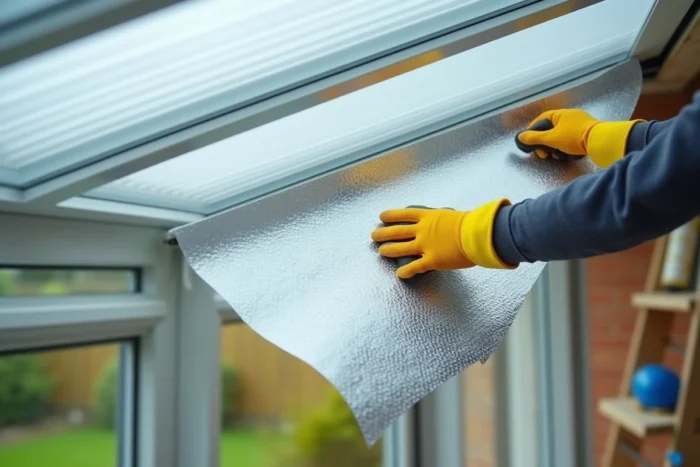
- Thermal film is applied directly to the existing panels, retains the transparency of the polycarbonate, and can be removed without damage. It is the best-documented solution for conservatories where brightness is to be preserved
- Reflective paint or lacquer (such as Meudon white applied as a temporary layer) reduces solar transmission but partially obscures the roof. It is more suitable as a very low-cost seasonal solution
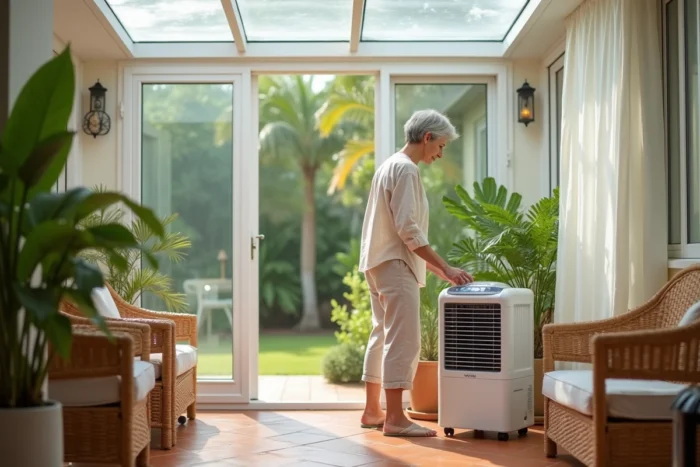
- Air conditioning (split or portable) addresses the symptom without tackling the cause. Without prior solar protection, the energy consumption of an air conditioner in a polycarbonate conservatory becomes disproportionate
The most coherent scenario is to first address the roofing (film, multilayer lining, or external protection), then optimize nocturnal ventilation, and finally consider mechanical assistance if comfort remains insufficient. Reversing this order means constantly compensating for a lack of insulation with energy, which makes no thermal or economic sense.
The main difficulty remains the orientation and glazed surface of each conservatory, two parameters that determine the actual effectiveness of each solution. A diagnosis by a professional in carpentry or insulation can help avoid poorly calibrated investments, especially in large conservatories where temperature differences between exposed and shaded areas complicate choices.