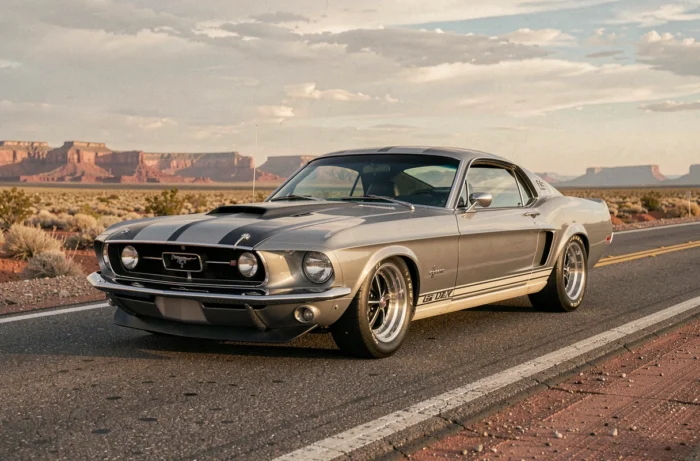
The Ford Shelby GT500 Eleanor never existed in a manufacturer’s catalog. This name refers to a heavily modified 1967 Mustang Fastback, made famous by the film “Gone in 60 Seconds” (2000), and later produced as replicas and restomods by specialized builders. Understanding what one is actually buying under the name Eleanor requires distinguishing between the original period Shelby GT500, licensed replicas, and contemporary restomods with performance unrelated to the original.
Shelby GT500 Eleanor: differences between original, replica, and restomod
The 1967 Shelby GT500 left Carroll Shelby’s workshop with a 428 ci (7-liter) Ford Police Interceptor V8. It was the most powerful engine ever installed in a Mustang at that time. The total production of the first-generation GT500 (1967-1969) was limited to 6,430 units, which explains the rarity and current value of authentic models.
The term “Eleanor” encompasses three very different realities in the market. The first: a restored original GT500 dressed with the Eleanor body kit. The second: a standard 1967 Mustang Fastback (not a Shelby) transformed into a visual replica. The third: a full restomod based on 1967 with modern mechanics.
We recommend systematically checking the technical sheet of the Ford Shelby GT500 Eleanor before any transaction, as the value gap between these three categories is considerable. A replica based on a standard Mustang and a restomod based on an authentic Shelby do not play in the same league, either in terms of performance or heritage valuation.
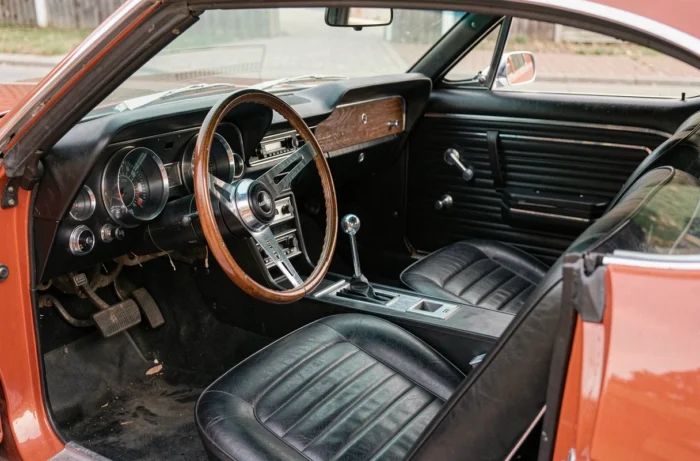
Engine and performance of modern Eleanor restomods
Current reproductions have nothing to do with the 1967 technical specifications. Revology, one of the most recognized builders in this segment, offers a reproduction of the 1967 Shelby GT500 equipped with a supercharged 5.0L V8 producing 710 hp. The acceleration figures speak for themselves: 0-60 mph in 3.7 seconds and the quarter mile in 11.7 seconds.
These performances place an Eleanor restomod at the level of a contemporary supercar, wrapped in a 1960s body. The contrast between the vintage lines and modern mechanics is precisely what makes these machines appealing.
What changes compared to the original block
The 428 ci V8 of 1967 delivered significantly lower power than current builds. Beyond the engine, modern restomods generally incorporate:
- A 6-speed manual transmission or a modern automatic transmission, replacing the original 4-speed manual
- Ventilated disc brakes on all four wheels with high-performance calipers, whereas the original had rear drums
- Independent suspension on all four wheels with adjustable dampers, radically transforming road behavior
- Recalibrated power steering and a reinforced chassis to handle the increased power
The result is a car that drives like a recent model while retaining the aesthetics that made it legendary.
Price of the Ford Shelby GT500 Eleanor: a highly segmented market
A licensed Eleanor can reach staggering heights at auction. A “1967 Ford Mustang Eleanor Licensed 25th Anniversary Limited Edition” sold for $500,000, a level that far exceeds that of a simply restored 1967 Mustang.
The market is structured in distinct tiers. Visual replicas based on standard Mustang Fastbacks, with a modest displacement V8 and no official license, trade for a fraction of the price of a licensed model. High-end restomods with modern mechanics and meticulous finishes occupy the mid-range segment. Licensed limited edition examples, documented and numbered, achieve the highest valuations.
Factors that influence the value of an Eleanor
The official Eleanor license remains the primary valuation criterion. Since the legal disputes surrounding the trademark, only examples with an authentic license receive recognition in the serious collector market.
The number of construction hours is a reliable indicator of the quality of a replica. Some documented examples show over 4,000 hours of work, justifying a high price positioning. The traceability of the base (original Shelby VIN number or standard Mustang) directly influences resale value.
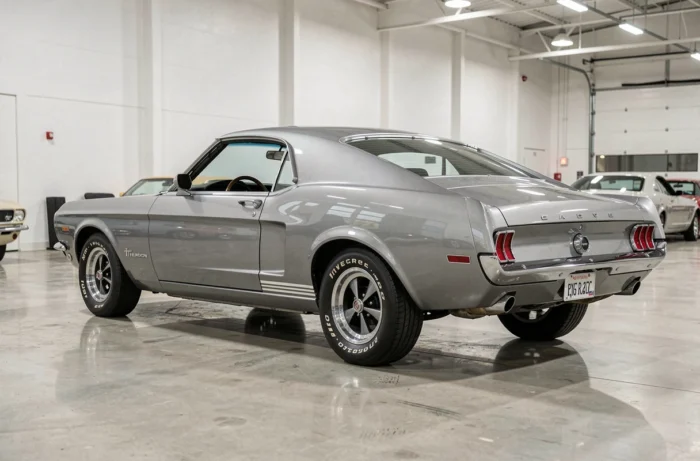
Buying an Eleanor in France: import constraints and homologation
The French market for the GT500 Eleanor remains niche. Almost all available examples come from the United States, which imposes an import process with its specific constraints.
Homologation for classic car registration simplifies the procedure for models based on 1967, provided the vehicle is over 30 years old. This registration imposes restrictions (adapted technical control, recommended non-daily use) but avoids current anti-pollution standards, a crucial point for a high-displacement V8.
For restomods equipped with modern engines, the situation becomes more complicated. A supercharged 5.0L V8 in a 1967 body can pose compliance issues if the vehicle is not declared as a classic. We observe that some buyers opt for registration in a more lenient European country before transferring to France, a practice that carries its own legal risks.
Gasoline engines and manual transmissions remain the most sought-after configurations in this segment. Offers with automatic transmissions exist but resell less easily among enthusiasts, who prefer the driving experience closest to the original spirit.
The Eleanor market does not follow the same cycles as that of the general classic car market. The cinematic dimension of the model gives it a notoriety that transcends the circle of Mustang collectors, which supports prices even during corrections in the rest of the American vintage market.