The second year, the first year, the final year: each level of high school imposes a different rhythm, workload, and stakes. The answer to the question “which year is the easiest in high school” directly depends on the structure of the current baccalaureate, where continuous assessment accounts for 40% of the final grade. Understanding the real weight of each year allows students to adjust their efforts at the right time.
Weight of continuous assessment and point distribution in the baccalaureate
The general and technological baccalaureate is calculated on 2,000 points. The final exams represent 1,200 points, and continuous assessment provides 800.
These 800 points come from the annual averages of the first and final years in the common core subjects (history-geography, modern languages A and B, scientific education, physical education, civic education). They are validated in the class council and then integrated into the school report.
The second year, on the other hand, generates no points for the baccalaureate. The grades obtained that year do not appear in the calculation of the diploma, nor directly in the Parcoursup file. This is what makes the second year the year with the lowest certification pressure. To delve deeper into this topic, high school tips on Mindtrap detail the mechanisms that make this year less burdensome in terms of stakes.
To say that the second year is “easy” remains a simplification. The curriculum introduces new subjects and a higher level of expectation than middle school. The absence of certification stakes does not mean the absence of difficulty, but it offers a margin for error that the first and final years no longer allow.

General second year: why this year seems more accessible
Several concrete factors explain the perception of a “easier” second year.
- The curriculum remains general. Students follow a common core without specialization, which avoids the overload associated with choosing a track. The diversity of subjects allows compensating for weaknesses in one discipline with good results elsewhere.
- Assessments primarily serve to guide. The class councils of the second year aim to guide the choice of specialties, not to penalize an insufficient level for the baccalaureate. The right to make mistakes still exists.
- The weekly course load is around 26 to 28 hours, compared to sometimes heavier weeks in the first and final years when adding specialty hours and options.
This configuration makes the second year a year of transition and adaptation to the rhythm of high school. Students who approach it with a minimum of method generally come out without major setbacks.
First and final years: what complicates the situation
From the first year, continuous assessment begins to contribute to the baccalaureate grade. Every term counts. The annual averages of all common core subjects are transmitted to the school report.
The anticipatory French exam in the first year
French is the only final exam taken at the end of the first year. It combines a written component (commentary or essay) and an oral component based on a list of texts studied throughout the year. This exam represents a significant coefficient and often constitutes the first national exam that students face. Preparing for the oral exam, with the memorization of linear analyses and mastery of text grammar, represents a concentrated effort over a few months.
The final year and the convergence of deadlines
The final year accumulates specialty exams, philosophy, the grand oral, and Parcoursup files. Between January and June, high school students simultaneously manage their revisions, the preparation of their orientation wishes, and the writing of motivation letters.
This overlap of deadlines makes the final year the densest year, not necessarily the most difficult intellectually, but the one where time management becomes a determining factor.
Working method in the second year: laying the foundations without pressure
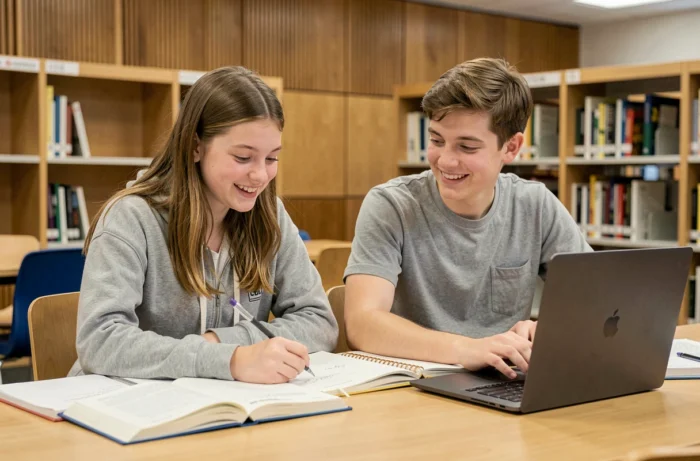
Since the second year offers a less constrained framework, it is the time to establish work habits that will serve in the following two years. A few practices make a measurable difference in the long term.
- Reviewing lessons the same evening. Short-term memory retains more when the review occurs within hours of the lesson. Waiting until the weekend means having to relearn instead of consolidating.
- Keeping a paper or digital planner up to date. High school teachers do not always remind students of deadlines. Noting each assignment as soon as it is given prevents forgetfulness and reduces last-minute stress.
- Identifying weak subjects before the All Saints’ Day break. The first evaluations reveal gaps compared to the expected level. Asking for help early (teacher, classmate, online resource) prevents the accumulation of gaps.
These reflexes may seem basic. They are. But the majority of dropouts in the first year find their origin in uncorrected methodological gaps from the second year.
Mental health in high school: a parameter not to be neglected
Recent data show a deterioration in mental health among high school students. Documented depressive and anxious risks have increased in recent years, linked to academic pressure, intensive screen use, and uncertainty regarding orientation.
A high school student who sleeps poorly, accumulates fatigue, or goes through a prolonged period of stress will see their results decline regardless of the year. The second year, perceived as lighter, can also be the time when these difficulties settle in without being detected, precisely because the absence of visible pressure masks a growing malaise.
Maintaining a regular sleep schedule, keeping activities outside of school, and discussing any difficulties with a trusted adult are simple measures whose effect on academic success is direct.
The second year remains the year with the lowest certification stakes, making it, on paper, the “easiest.” But this relative simplicity only holds if it serves to build a solid working method. Baccalaureate points are at stake from the first year: a student who arrives in the first year with good habits and preserved sleep approaches the final cycle under the best possible conditions.