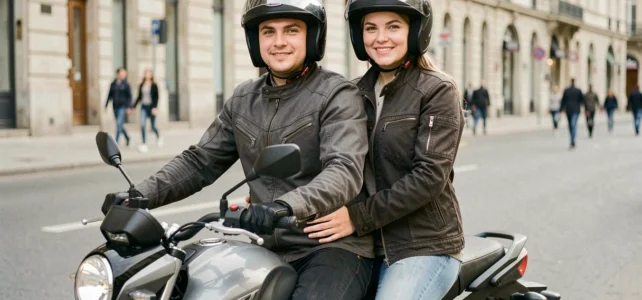
Choosing a 125 motorcycle for riding two-up is not just about finding a powerful or cheap model. The additional weight of a passenger alters the behavior of the machine in several ways: suspension, braking, and cornering stability. Among the 125 models available on the market, only a few are truly designed for this use, and the differences between models are more pronounced than one might think.
Suspension and Travel: The Criteria Hidden in Technical Sheets
On a 125 loaded with two people, the rear suspension absorbs most of the additional weight. Most entry-level models come with non-adjustable shock absorbers, calibrated for a solo rider weighing around 75 kg. Adding a passenger weighing 60 to 70 kg keeps the shock absorber working close to its limit.
Motorcycles equipped with a rear suspension adjustable in multiple positions offer a measurable advantage for two-up riding. Honda, on the CB125F, offers an adjustable preload shock. Yamaha, with the YS125, adopts a similar configuration. These adjustments allow for compensation of the load and help maintain good handling in corners and during braking.
In contrast, a sporty roadster model like the KTM Duke 125, despite its sharp chassis, prioritizes solo responsiveness. Its short geometry and firm suspension make two-up riding significantly less comfortable on the road.
Anyone looking for a comfortable 125 motorcycle for riding two-up should first check for the presence of an adjustable rear preload and the length of the travel before considering engine power.
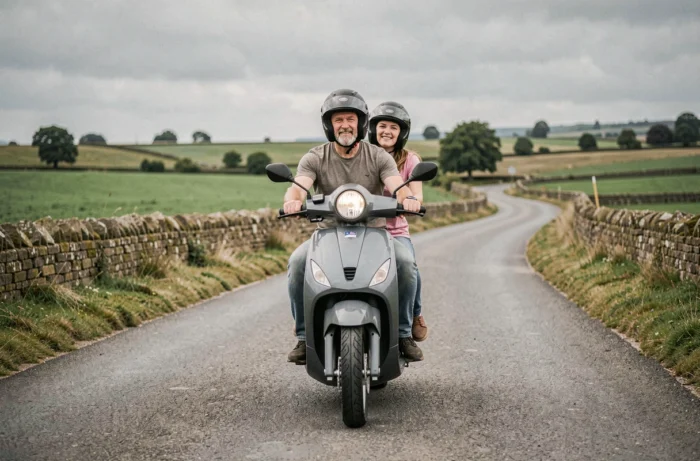
Comparison of 125 Models Suitable for Two-Up Riding: Seat, Position, Engine Torque
Not all models are equal when a passenger gets on. Three parameters separate the 125s that are truly usable for two-up riding from the others: the rear seat area, the riding position, and the engine torque available at low revs.
| Model | Type | Two-Up Seat | Adjustable Preload | Engine Torque |
|---|---|---|---|---|
| Honda CB125F | Touring | Wide, flat | Yes | Consistent from low revs |
| Yamaha YBR 125 | Touring | Wide | Yes | Soft, suitable for two-up |
| Honda Varadero 125 | Road Trail | Spacious, with passenger grips | Yes | Two-cylinder, strong acceleration |
| Yamaha X-Max 125 | GT Scooter | Very wide, backrest available | No (reinforced shocks) | Torque-rich single-cylinder |
| KTM Duke 125 | Sport Roadster | Narrow, short | No | Peaky, little torque at low revs |
The table highlights a clear divide. Touring bikes and trails feature a wide seat and early engine torque, two key qualities for two-up use. Sport roadsters sacrifice these aspects for the sake of lightness and handling in solo riding.
Honda Varadero 125: The Reference for Two-Up in the Used Market
The Varadero 125 remains the most cited model by users for two-up riding, even though its production has ceased. Its two-cylinder engine delivers usable torque without needing to rev high, which reduces fatigue on long trips. Its wide seat with integrated grab handles and well-positioned passenger footpegs make it the most accomplished 125 for riding two-up on the road.
Its trail dimensions also provide sufficient ground clearance to avoid bottoming out with two occupants, a common issue with low roadsters.
Honda CB125F and Yamaha YBR 125: The City-Road Compromise
These two touring models share a common philosophy: upright position, flat seat, and low maintenance. Their single-cylinder engine lacks the character of a twin-cylinder, but their consistent torque is suitable for urban and suburban trips with two.
The CB125F has a more modern look and a low fuel consumption. The YBR 125, while aging in design, maintains a reputation for mechanical reliability that reassures for daily loaded use.
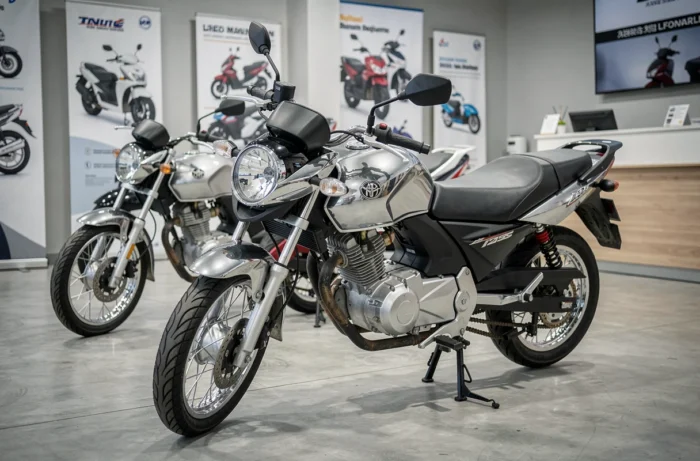
Motorcycle Technical Inspection and Two-Up Use: A Constraint to Anticipate
The technical inspection for motorized two-wheelers has been mandatory in France since April 15, 2024 for all vehicles in category L, including 125 motorcycles and scooters. The schedule requires an initial inspection based on the year of registration: 125s registered before January 1, 2017, must be inspected before December 31, 2024, and those registered in 2020 or 2021 are due in 2026.
Regular two-up use accelerates the wear of three components checked during the inspection: brake pads, rear tires, and shock absorbers. A 125 used primarily solo can pass without difficulty, whereas the same model used two-up shows premature wear of these elements.
- Rear brake pads wear significantly faster with a passenger, as the extra weight increases braking distances and puts more strain on the rear brake.
- The rear tire experiences a constant higher load, which reduces its lifespan and can cause detectable asymmetrical wear during inspection.
- The rear shock absorbers operate at the limit of their travel, which accelerates the loss of efficiency of the seals and hydraulic fluid.
Choosing a 125 motorcycle designed for two-up riding, with components sized for this load, reduces the risk of a re-inspection and limits maintenance costs in the medium term.
A1 License and Power Limited to 11 kW: What This Changes for Two-Up Riding
All 125 motorcycles are restricted to 11 kW, or 15 hp maximum. This legal limit, which is the same regardless of the model, means that raw power is not a differentiating criterion. However, the way this power is delivered radically changes the two-up riding experience.
An engine that develops its maximum torque at mid-rev range (around 6,000 to 7,000 rpm) allows for effortless acceleration with a passenger. An engine that requires revving to 9,000 rpm to find its power forces constant downshifting, which tires the rider and makes overtaking more challenging.
The power-to-weight ratio also plays a role. Two occupants on a 125 weighing 130 kg do not produce the same sensation as on a model weighing 160 kg. The lighter machine retains better acceleration capability, but the heavier one (often a trail or touring bike) offers superior stability at constant speed on the road.
The trade-off is therefore between agility and stability, and two-up riding systematically leans towards stability. A touring bike or a 125 trail, even if heavier, remains the most coherent choice for regular two-up trips.