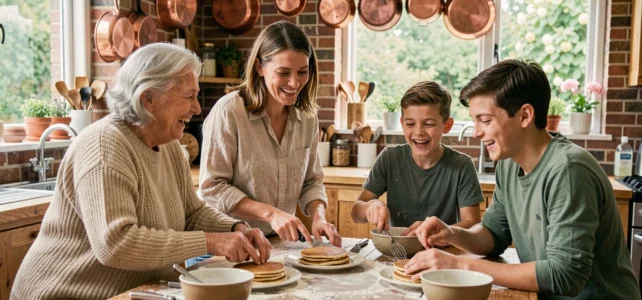
Family ties do not deteriorate due to a lack of love or goodwill. They erode when days go by without a single shared moment being predictable, anticipated, or repeated. A family ritual, in the behavioral sense, is a brief, recurring action identifiable by all household members, which creates a positive expectation and a sense of belonging. Strengthening family ties on a daily basis relies less on occasional grand outings than on these regular micro-sequences.
Spousal spillover effect: why the couple’s relationship shapes the family climate
A study published in July 2025 in Social Psychological and Personality Science (Ni Yan et al.) shows that daily spousal interactions “spill over” into parenting on the same day. Days marked by more conflicts between spouses are accompanied by more negative interactions with children. Conversely, days when the couple shares warm exchanges see more positive parent-child relationships.
This mechanism, called spousal spillover effect, means that investing in the couple’s relationship is not a selfish luxury. It is a direct lever on the quality of the bond with the children.
Another study, published on August 5, 2026, in Family Relations, specifies that exercising together as a couple is associated with better communication, better management of disagreements, and less marital stress compared to exercising separately. The mechanism is not the intensity of the sport, but the fact of sharing a common effort and rhythm.
Walking together after dinner, running in the morning before the children wake up, or following a yoga session in the living room is enough, as long as it happens regularly. Concrete ideas and additional reflections on family life are available at https://lavoiedelafamille.com/, a site that addresses these topics from several practical angles.

Repeatable family rituals: regularity matters more than duration
The main obstacle to family rituals is not a lack of time. It is excessive ambition. Planning a board game night every Friday works the first week, then fades away in the face of fatigue or unforeseen events. A ritual that lasts over time has three specific characteristics:
- It lasts less than twenty minutes and requires no logistical preparation (no materials to set up, no travel)
- It is anchored to an already existing moment of the day (dinner, car ride, bedtime), making it automatic rather than voluntary
- It allows each family member to participate according to their age and energy, without performance pressure
A realistic ritual attaches itself to a routine; it does not replace it. Asking an open-ended question at the table (“What surprised you today?”) takes less than ten seconds to initiate. The following turn of speech creates a regular communication space without turning dinner into a formal meeting.
Adapting the ritual to remote work constraints
Remote work blurs the boundary between physical presence and real availability. A parent can be in the next room all day without having a single quality exchange with their children. Setting a micro-transition ritual, like a shared coffee break at a fixed time or five minutes of discussion after shutting down the computer, materializes the shift between professional time and family time.
This time marker also helps children understand that the parent, even when visible, is not always accessible, and that the shared moment is all the more valuable because it is clearly defined.
Screens and family ties: setting a framework without prohibiting
The question of screens in the family rarely arises in terms of total duration. The real issue is the simultaneous use of separate screens in the same space. Four people in a living room, each on their phone, share nothing. The same family watching a movie together, even on one screen, experiences a shared moment that can generate discussions.
Rather than rigid rules about screen time, an effective framework relies on two simple principles:
- Identify one or two moments of the day when phones are physically placed elsewhere (during meals, during the bedtime ritual)
- Favor shared uses (cooperative video games, joint viewing, video calls with a distant grandparent) over isolated uses
- Apply the same rule to parents and children, which reinforces trust and a sense of fairness within the household
Children integrate a framework they see respected by adults. A parent who checks their phone at the table while prohibiting the same action for their children undermines their credibility and the ritual itself.
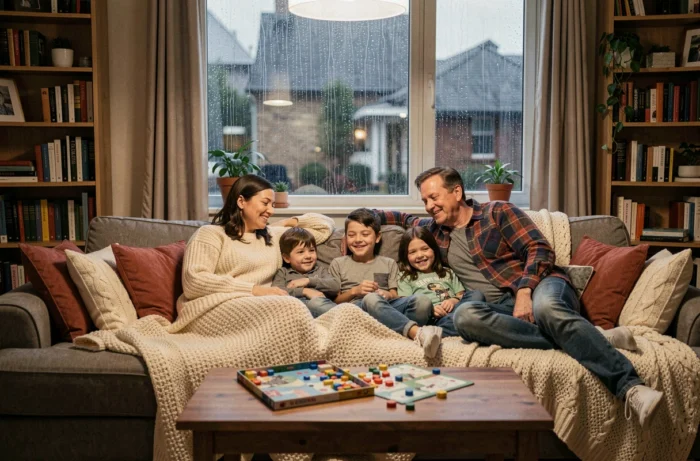
Geographic distance and family ties: effective long-distance rituals
When family members live far apart, the weekly phone call remains the most common format. Its effectiveness depends on its predictability. A call “when we think of it” eventually becomes spaced out. A call on Sunday at 6 PM, even brief, becomes an expected marker.
Distant grandparents can maintain a strong bond with simple rituals: reading a story via video call at bedtime, sending a handwritten postcard every month, or sharing a digital photo album fed by both sides. The regularity of contact matters more than its duration or technical richness.
When distance reveals intention
A ritual maintained despite distance sends a powerful signal to both children and adults. It says that family ties are not a byproduct of geographic proximity, but an active, repeated choice that withstands logistical constraints.
Strengthening family ties does not require a special budget or exceptional availability. The determining factor remains the ability to transform a vague intention into a concrete, brief gesture, and above all, repeated often enough for each household member to eventually look forward to it.