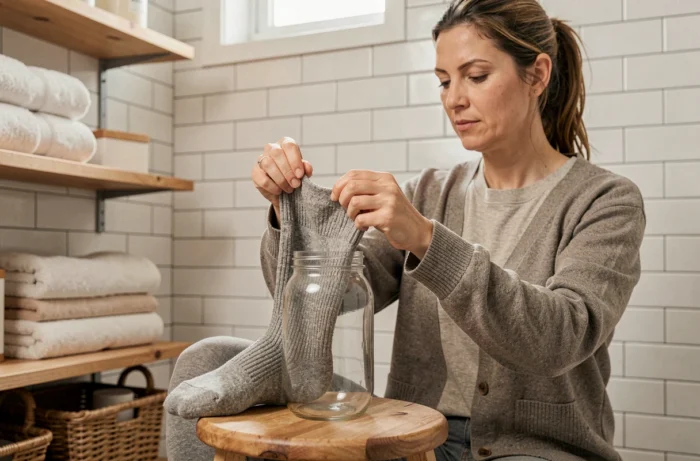
Your socks leave red marks on your ankles after a few hours. The elastic compresses the calf, circulation slows down, and each step becomes an unpleasant reminder. Before tossing these pairs to the back of the drawer, several methods allow you to widen overly tight socks without special equipment, right at home.
Textile fibers and elasticity: why your socks tighten
Most commercial socks contain a blend of cotton, polyamide, and elastane. It is the latter component that provides the “stretch” effect. With repeated washes, especially at high temperatures, elastane contracts instead of relaxing.
The dryer accelerates this phenomenon. Intense heat tightens synthetic fibers and shrinks the knit. A sock that fit you perfectly at purchase can become uncomfortable after about ten cycles of mechanical drying.
Have you ever noticed that a wool sock does not react the same way as a mixed cotton sock? Wool felts under the combined effects of heat, moisture, and friction. Widening it requires a different approach than that used for cotton. Understanding the dominant fiber of your pair means choosing the right method from the start.
Among the tips from Paris Avenue, this logic of adapting to the fabric before any manipulation is also found.
Wet stretching: the most effective method for widening socks
Warm water remains the best ally for relaxing the fibers of an overly tight sock. The principle is simple: moisture softens the knit and makes it pliable, allowing you to stretch it manually without tearing it.
Here’s how to proceed:
- Soak the pair in a basin of warm water (not hot) for about fifteen minutes, until the fabric is well soaked.
- Gently wring it out without twisting, then slip each sock over an object wider than your foot: a plastic bottle, a tin can, or a slightly inflated balloon.
- Let it air dry, flat or on the support, for several hours. The fabric will take the shape of the object as it dries.
- Repeat the operation if the result is insufficient after the first attempt.
Stretching should always be done on damp fabric, never dry. When dry, you risk breaking the elastane fibers rather than elongating them. The result would be a sock deformed in places and still tight in others.
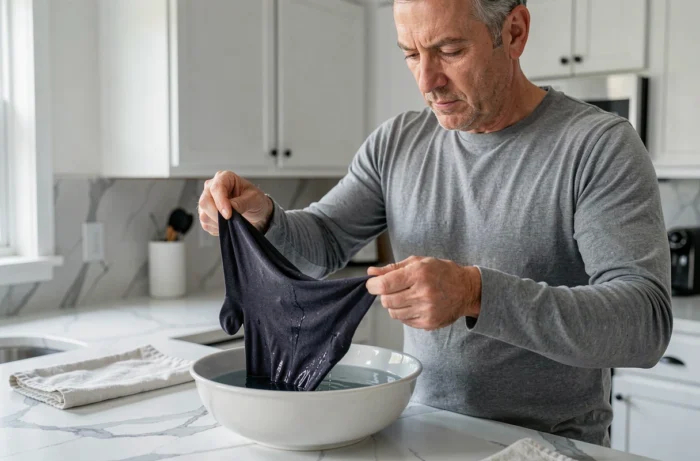
The choice of support matters. A one-and-a-half-liter soda bottle, with its flared shape at the bottom and narrowed at the neck, closely resembles the geometry of the foot and ankle. An inflated balloon to the desired size offers a more uniform stretch, especially for the toe area.
Fabric softener and white vinegar: relax the elastic without damaging the knit
When the elastic at the top edge is the main culprit for compression, a targeted soak softens this area without altering the rest. Classic fabric softener works well on synthetic fibers.
Dilute a dose of fabric softener in a liter of warm water. Soak only the upper part of the sock (the ribbed edge) in this mixture for about thirty minutes. Rinse with clear water and manually stretch this area before letting it dry.
White vinegar is an alternative for cotton or wool socks. It relaxes the natural fiber without leaving chemical residue. The proportion: about a glass of white vinegar for two liters of warm water. The soaking time is the same.
Never combine fabric softener and vinegar in the same bath. Their mixture neutralizes each other’s effect and yields no results.
Precautions for sensitive feet: when widening is not enough
Stretching an overly tight sock solves a temporary comfort issue. However, for people suffering from circulatory disorders or diabetes, this home solution has its limits.
Medical recommendations published since 2023 emphasize wearing non-elastic socks, without thick seams at the toe area, and sufficiently soft to leave no deep marks on the skin. Modifying a standard sock by hand does not guarantee these criteria.
A key point to remember: you cannot transform a compression sock into a soft sock (or vice versa) by relaxing it yourself. Graduated compression meets precise medical specifications. Stretching it alters the pressure distribution in unpredictable ways, which can worsen a venous problem instead of relieving it.
If your socks consistently leave deep marks despite a proper size, a medical opinion is better than another tip.
Daily maintenance: keep your socks the right size
Air drying preserves elasticity much better than the dryer. This is the simplest and most effective gesture to prevent the problem from recurring after each wash.
Wash your socks at low temperatures. Most synthetic fibers and cotton clean perfectly at 30 degrees. Turn them inside out before putting them in the machine to protect the outer surface from drum abrasion.
For wool socks, hand washing in barely warm water remains the safest method. Dry them flat, reshaping them with your hands while they are still damp.
One last detail: store your socks flat or rolled, not crumpled with the elastic folded over itself. This common habit stretches the ribbed edge in the wrong direction and accelerates its deformation. Keeping the original shape starts right from the drawer.