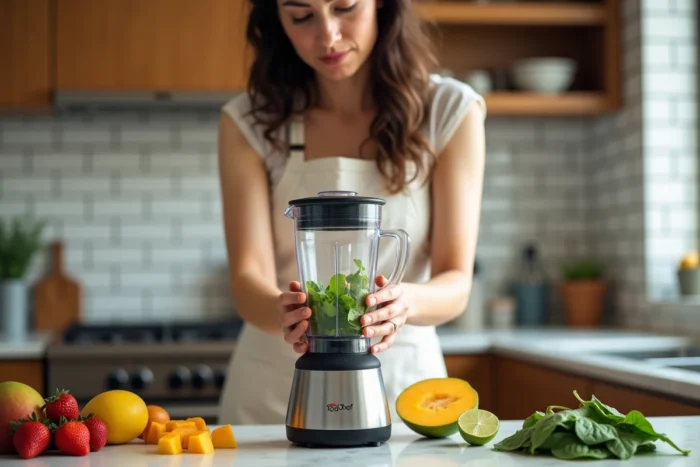
A blender branded Top Chef is distinguished not by its logo, but by its ability to produce a smooth texture in challenging preparations: pesto made from dried fruits, root vegetable purées, emulsified fillings. We observe that most disappointments stem from a poor match between the blade profile, the bowl volume, and the viscosity of the intended preparations.
Blade Geometry and Vortex: The Parameter That Comparisons Overlook
Motor power dominates product specifications. It matters, but it’s the blade geometry that determines the quality of the vortex. A four-blade design staggered on two levels creates a downward spiral movement that draws the material toward the center. A flat blade, even when paired with a powerful motor, leaves food compacted under the blades.
The blenders used on professional film sets (including Top Chef) share a common feature: a pronounced attack angle on the upper blades, which pulls the ingredients downward. This detail explains why some devices with modest power produce a smooth pesto, while a super-powered model merely chops without blending.
When evaluating the Top Chef blender, pay attention to the shape of the blade block before looking at the wattage. A removable blade block also makes it easier to clean out fibrous residues stuck at the base.
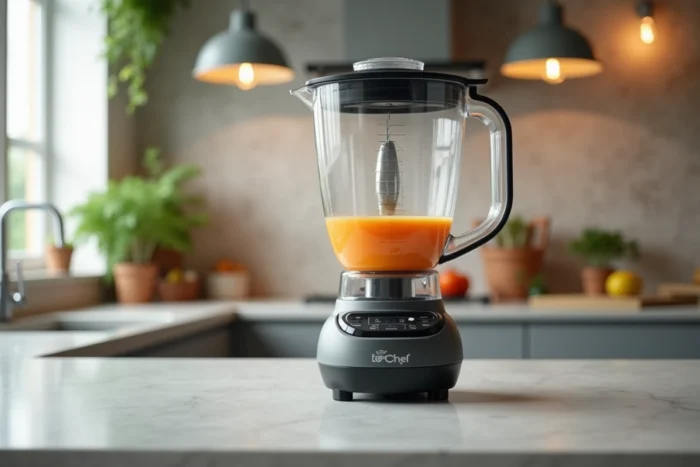
Borosilicate Glass or Tritan: Which Material for Intensive Use
Borosilicate glass withstands thermal shocks much better than regular glass. Pouring hot broth directly into the bowl without risk of cracking is a non-negotiable criterion for soups and purées. Tritan (BPA-free copolyester) offers appreciated lightness and good scratch resistance, but it tends to warp after several months of intensive use with colorful preparations (beetroot, turmeric).
We recommend borosilicate glass for regular family use. Tritan is better suited for portable or occasional use, where the weight of the bowl matters more than its aesthetic longevity.
Usable Capacity vs. Advertised Capacity
A bowl advertised as 1.5 liters does not allow for blending 1.5 liters of soup. The usable capacity, which is below the safety limit of the lid, generally represents two-thirds of the total volume. Check the internal markings of the bowl rather than the marketing figure on the packaging.
Food Compliance of Seals and Soft Parts: An Underestimated Angle
Buying guides focus on the tank and blades. Soft parts (O-rings, sealing sleeves, handles) often go unnoticed. However, food-grade elastomers are subject to regulatory hardening in Europe. Germany has published an update to its recommendations on materials in contact with food, with an enforcement date of June 1, 2026, for thermoplastic elastomers (TPV).
This change directly affects blender seals exposed to heat and food acids. A non-compliant seal can release peroxides beyond acceptable thresholds, an invisible risk documented by control laboratories. The “BPA-free” labeling does not cover this type of chemical migration.
In practice, prioritize manufacturers who communicate about the compliance of their soft parts, not just their tank. A device whose seal degrades after a few months of hot preparations poses a health issue as well as a functional one.
Balancing Power, Volume, and Frequency of Use
A compact blender is sufficient for daily solo use (smoothies, compotes). For family preparations or demanding textures (nut purées, crushed ice), a motor capable of maintaining its speed under prolonged load makes a difference. The 2026 trend confirms a clear segmentation:
- Compact models (less than one liter of usable capacity): individual smoothies, light sauces, quick daily use. Modest motor but sufficient for liquid textures.
- Family blenders (one liter and more of usable capacity): soups, pestos, fillings. Motor sized to run for several minutes without overheating, blades with optimized geometry for the vortex.
- Heating blenders: integrated cooking and blending, suitable for purées and compotes. Convenient, but cleaning the internal heating element requires more care.

The Question of Speed Control
A progressive speed controller (not fixed steps) allows for real-time texture adjustments. For pesto, starting at low speed incorporates the oil without excessively emulsifying, then increasing the speed refines the granularity. Fixed steps force a choice between too fine and too coarse.
Maintenance and Durability of the Motor Block
A blender used several times a week accumulates residues in the base, between the blade block and the seal. We observe that most early failures stem from clogging in this area, not from motor failure.
Disassemble the blade block after each use and rinse it separately. A quick pass of soapy hot water in the bowl, followed by a few seconds of running empty, is sufficient for daily maintenance. A thorough weekly cleaning (soaking the seal, brushing the base) significantly extends the lifespan of the entire unit.
- Ensure that the blade block can be disassembled without tools: a welded block complicates maintenance and prevents seal replacement.
- Prefer a base with non-slip feet and low ventilation: motor overheating is the primary cause of gradual power loss.
- Keep the manual to identify compatible spare parts: the availability of parts over several years is an indicator of manufacturer quality.
The choice of a high-performance blender relies less on the displayed wattage than on the compatibility between blade geometry, bowl material, and actual frequency of use. A device well-sized for your usual preparations, with compliant soft parts and a removable blade block, will serve you longer than a super-powered model whose seal fails after six months.