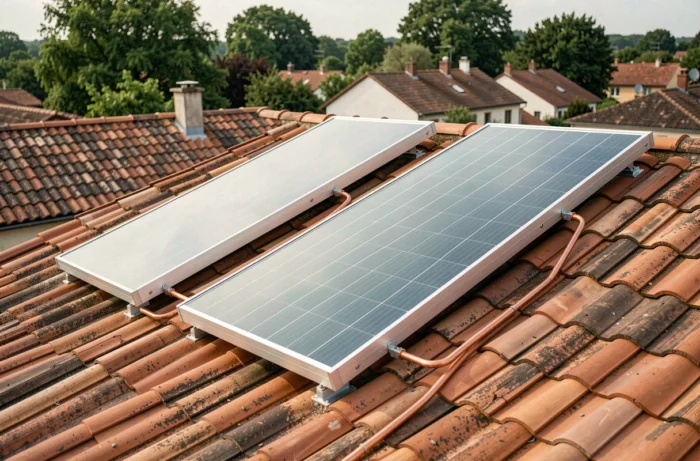
Solar thermal heating is based on an ancient physical principle: capturing sunlight to convert it into heat. Applied to the production of domestic hot water, this system now equips homes in all French regions, including those with moderate sunshine. Its operation involves a few simple components, but their interaction raises technical questions that usual descriptions often overlook.
Summer overheating of solar thermal collectors: an underestimated problem
The circuit between collectors, storage tank, and backup system forms the basis of the solar water heater. However, the question of how the installation behaves when no one is drawing hot water while the sun is shining strongly deserves equal attention. It is a major sizing constraint.
In summer, when the demand for hot water decreases (vacation, unoccupied house), the heat transfer fluid continues to circulate in the collectors exposed to radiation. The temperature in the panels can then rise well beyond nominal thresholds. This phenomenon, called stagnation, degrades the glycol used as the heat transfer fluid. It can also cause steam bursts in the circuit, damage seals and fittings, and reduce the lifespan of the installation.
To understand the operation of solar thermal heating as a whole, this constraint must be integrated from the design stage. Several strategies exist: slightly oversizing the tank to absorb excess, installing a thermal dissipation device (air heater, discharge loop), or opting for so-called “drain-back” collectors that automatically empty the circuit when there is no heat demand.
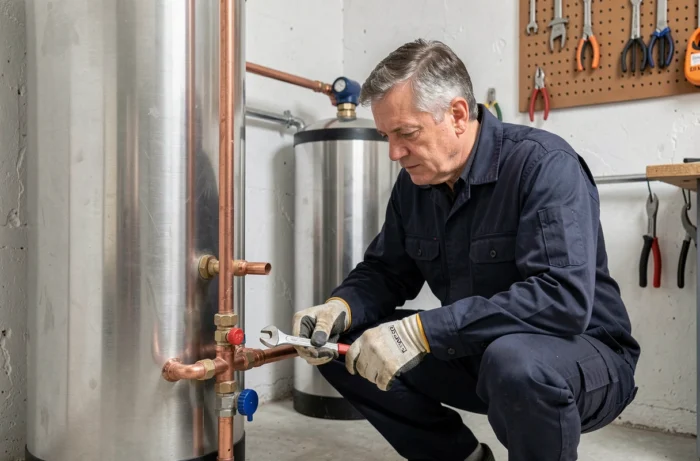
The choice between these solutions depends on the local climate, the volume of the tank, and the household consumption profile. An installer who does not address the issue of summer overheating overlooks a key technical parameter.
Hydraulic circuit and heat transfer: what happens between the roof and the tank
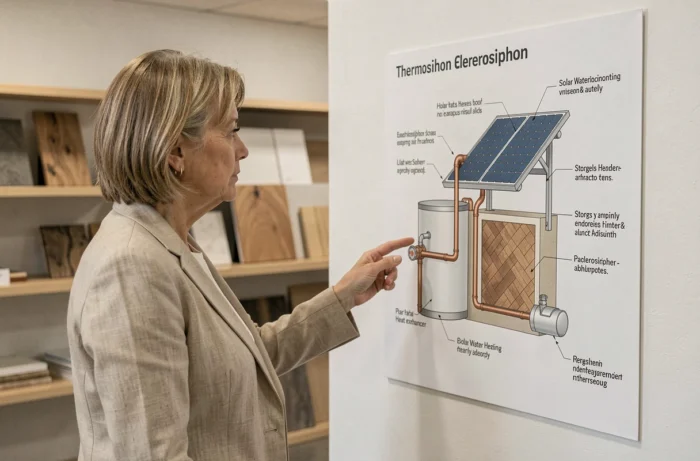
A solar thermal system for domestic hot water consists of three components: the collectors on the roof, the storage tank, and the circuit connecting the two. The heat transfer fluid (usually a mixture of water and antifreeze glycol) circulates in a closed loop.
- The solar thermal collectors, most often flat-plate, absorb radiation thanks to a selective black surface placed under a glazing. The air trapped between the glazing and the absorber creates a localized greenhouse effect that raises the temperature of the fluid.
- The heated fluid descends to the tank and passes through a heat exchanger (coil or double jacket). It transfers its heat to the stored domestic water, then rises back to the collectors, cooled, for a new cycle.
- A circulation pump (or simple natural convection in thermosiphon systems) ensures the movement of the fluid. A controller compares the temperature of the collectors to that at the bottom of the tank and activates or stops the pump accordingly.
- The backup, electric or connected to a boiler, takes over when solar energy is insufficient to reach the desired temperature.
The solar tank operates by thermal stratification: hot water naturally rises to the top of the tank, while cold water remains at the bottom, where the solar fluid enters. This stratification improves the overall efficiency of the system, as the collector works with a cooler fluid, increasing the temperature difference and thus the efficiency of the transfer.
Thermosiphon or forced circulation
In a thermosiphon system, the tank is placed above the collectors. The circulation of the fluid occurs without a pump, due to the density difference between the hot fluid (lighter) and the cold fluid (heavier). This setup, common in very sunny regions, simplifies installation and eliminates the electrical consumption of the pump.
In mainland France, most installations use forced circulation. The tank is inside the house, often in the basement or in a technical closet, and a pump managed by the controller ensures the flow. This scheme offers more flexibility in the placement of components.
Water quality in the solar tank: a health risk not to be overlooked
Storing hot water in a tank entails a health responsibility. Legionella-type bacteria thrive between 25 °C and 45 °C. A solar tank that remains at an intermediate temperature for several days, due to insufficient sunlight and without activation of the backup, can become a conducive environment.
The backup is therefore not just a comfort: it plays a role in health prevention. Regulations recommend regularly raising the water temperature in the tank above the bacterial growth threshold. Some solar controllers integrate a periodic automatic heating function for this purpose.
This parameter conditions the choice of tank volume, the power of the backup, and the programming of the system. A tank that is too large compared to actual consumption increases the risk, as the water stagnates longer at a warm temperature.
Actual performance of solar heating: what affects efficiency
Solar thermal collectors can cover between half and four-fifths of annual hot water needs. This coverage gap does not depend solely on the region.
The consumption profile weighs as much as sunshine. A household that consumes most of its hot water in the morning and evening benefits less from solar energy than a household whose needs are spread throughout the day. The size of the tank must correspond to the volume actually used, not to a theoretical estimate.
The orientation and tilt of the roof also matter, but with more tolerance than often thought. A deviation of a few degrees from true south reduces production, without making the installation unviable. Solar obstructions (trees, neighboring buildings, terrain) deserve a serious shading study before any investment.
Maintenance and lifespan of solar thermal panels
A well-installed solar thermal collector has a long lifespan, often exceeding two decades. The heat transfer fluid, however, degrades over time and must be regularly checked and replaced. Degraded glycol loses its antifreeze and anticorrosion properties, which can silently damage the circuit.
Pressure control of the circuit, checking the tank’s anode, and occasional cleaning of the collectors’ glazing constitute the essentials of maintenance. Neglecting these operations means accepting a gradual decline in efficiency without immediate visible signs.
Solar thermal heating for domestic hot water production remains a reliable technology, provided it is not reduced to its only advantages. The sizing of the tank, management of summer overheating, and control of health risks are three parameters that separate a high-performing installation from underutilized equipment.