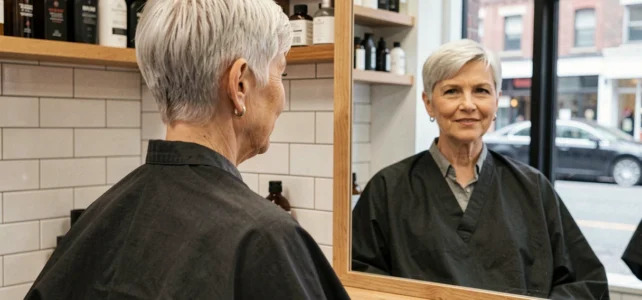
Hair fiber after 60 loses density, diameter, and natural hold. Choosing a short haircut in this context is not about a desire to “look younger” but rather a technical adaptation to hair that no longer reacts as it used to during styling. Here, we discuss the concrete criteria that make a short haircut hold on its own, without daily blow-drying, on mature hair.
Texture of Mature Hair and Choosing a Short Cut After 60
A fine and mature hair does not support the same structures as thick hair at 30. Keratin thins, the cuticle becomes more porous, and sebum production decreases. As a result, hair flattens more quickly and loses its volume within an hour after drying.
The 2026 trend confirms this shift. The haircut is decided first based on texture, not age. A fine wavy hair does not call for the same shape as fine straight hair at all. On wavy hair, a too-short layer on top crushes the emerging curl. On straight hair, a blunt bob without layering gives a helmet effect by the second day.
We recommend asking for a porosity and diameter diagnosis before making any haircut decisions. A stylist who suggests a pixie without assessing the hair’s elasticity is working blindly. Transitioning to a short haircut for older women benefits from being prepared over several sessions, gradually reducing the length to observe how the hair reacts at each stage.

Bixie, Shaggy Bob, and Nordic Bob: Volumizing Cuts Without Styling
The classic pixie remains a safe choice, but it often requires daily blow-drying or wax to maintain its structure. For women who want a beautiful cut right upon waking, without blow-drying, hybrid shapes are taking over.
The Bixie, Between Bob and Pixie
The bixie retains length on top and sides, with a nape that is exposed. This distribution creates natural volume at the crown, the area where mature hair flattens the most. The movement holds thanks to the weight of the upper strands, not due to styling products.
The Textured Shaggy Bob
The shaggy bob relies on uneven layers and a light fringe. The finishes are intentionally imperfect, which masks the loss of density much better than a geometric cut. Soft short replaces structured short in the current recommendations of stylists specializing in mature hair.
The Minimalist Nordic Bob
Noticed in rapidly increasing searches, the nordic bob (or nordic square) is characterized by a clean line, slightly rounded under the jaw, without marked layering. It works particularly well on white or salt-and-pepper hair, where the uniform color enhances the graphic effect of the cut.
White Hair and Short Cut: An Aesthetic Lever, Not a Constraint
We observe a clear change in the perception of white hair. White or salt-and-pepper is treated as an aesthetic asset, not as a sign to be concealed. This shift modifies the cutting criteria.
A white hair has a different texture: it appears thicker (the cuticle is more open), often drier, and sometimes slightly frizzy. Cuts that are too layered on white hair create a “cloud” effect that is hard to manage. In contrast, a cut with a bit of mass, like a bixie or short bob, channels this rebellious texture.
- On smooth white hair, favor a straight short bob or a nordic bob that takes advantage of the natural shine of white
- On wavy white hair, a shaggy bob with long layers preserves the curl without a frizzy effect
- On salt-and-pepper hair, subtle layers play with color contrast and give an impression of additional volume
Giving up coloring when transitioning to short simplifies maintenance and avoids visible regrowth at the roots, a recurring issue with long colored hair.
Maintaining a Short Cut on Fine Hair: Frequency and Products
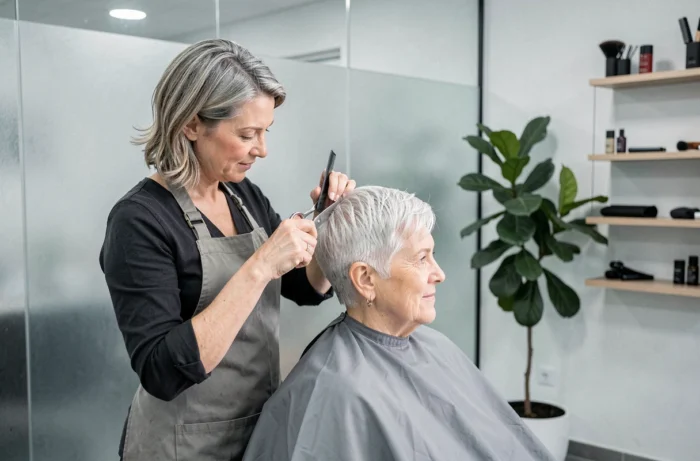
A well-executed short cut requires no less maintenance than a long cut. It requires a different kind. Refreshing every four to six weeks is a minimum to maintain the shape, especially on a pixie or bixie where the nape grows back quickly.
Regarding products, fine mature hair reacts poorly to sulfate shampoos that dry out, and to heavy silicones that weigh it down. We recommend:
- A gentle sulfate-free shampoo, applied only to the scalp to preserve the little sebum produced
- A light texturizing spray (rice powder or starch) to restore grip between washes without weighing it down
- A minimal leave-in treatment, applied only to the ends for cuts that retain a bit of length
Air drying works well on soft cuts (shaggy bob, bixie). On a structured pixie, a quick pass with the blow dryer upside down is enough to restore volume. Avoid direct heat on white hair, as the open cuticle makes it more vulnerable to drying out.
Face Shape and Minimum Length to Maintain
The shape of the face remains a technical parameter not to be overlooked. A round face benefits from keeping a bit of height on top (bixie, pixie with volume at the crown). An elongated face supports cuts with lateral volume better, like a slightly flared short bob.
Wearing glasses also alters the balance. Thick frames on a very short pixie create a disproportion. Adapting the length of the sides and fringe to the size of the frames avoids the effect of “face eaten by glasses.”
The fringe remains a powerful tool to soften features. A light curtain fringe, open in the center, frames the face without weighing it down and suits most face shapes after 60. It grows out without creating an awkward phase, unlike a thick straight fringe that requires frequent touch-ups.
The transition to short after 60 works when the cut embraces the reality of the hair as it is today, not as one would like it to be. A cut that holds effortlessly in the morning, absorbs regrowth without losing its shape, and highlights the natural color of the hair, including white: that is the only criterion that truly matters.